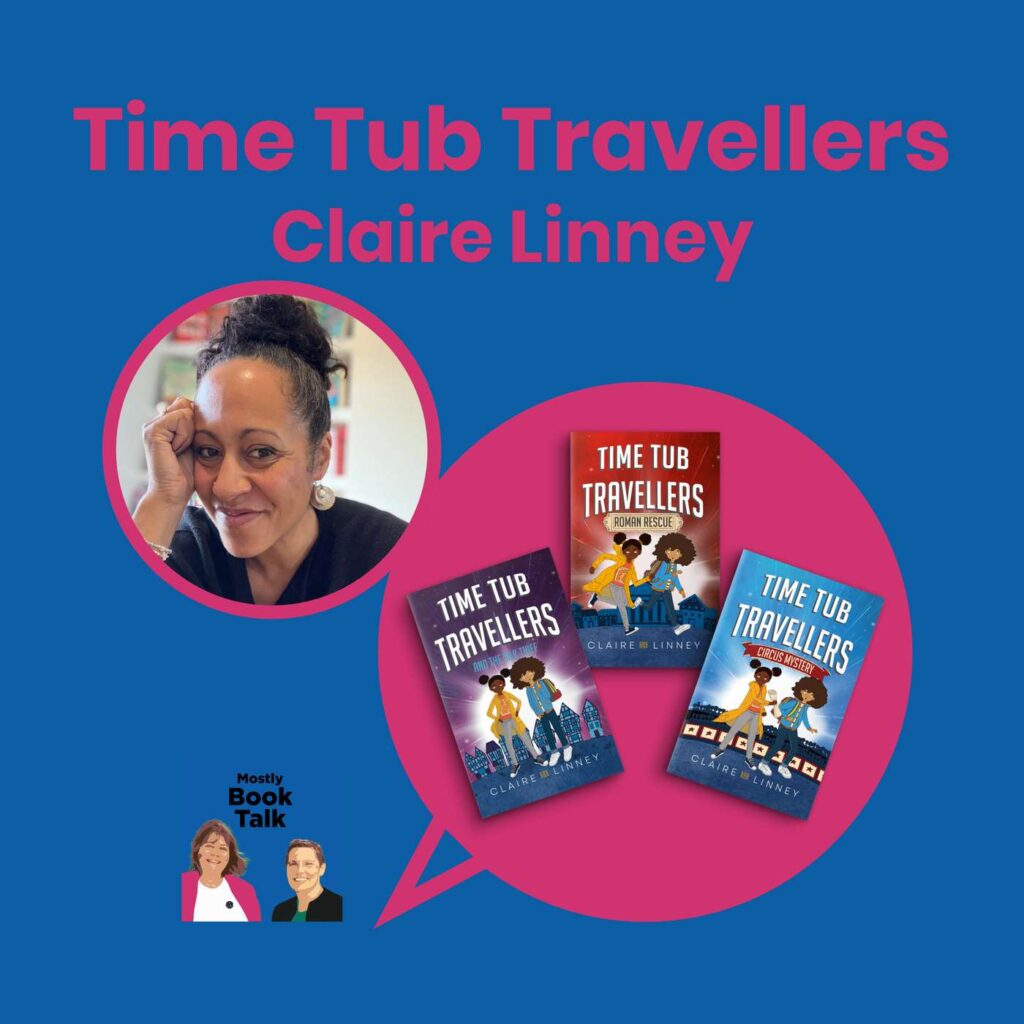
We talk with Claire Linney about her Time Tub Travellers series, the third book of which is out at the start of October 2026. Inspired by reading Black Tudors: The Untold Story by Miranda Kaufmann, Claire started researching Black British history and the stories that are too often untold and hidden. She decided she wanted to bring these stories to life in a fun, adventurous way for children and the result is her Time Tub Travellers books.
Time Tub Travellers and the Silk Thief
Time Tub Travellers: Circus Mystery
Time Tub Travellers: Roman Rescue
Claire is a champion of diversity in children’s books – you may have seen her on TikTok and Instagram – and has also navigated the world of self publishing.
We talk about all of these things and Claire also has some great book recommendations.
To find out more about Claire, her books and school visits take a look at her website . You can also buy signed copies of her books there.
Katy
0:11
Hi, I'm Katie. Hi, I'm Ali, and welcome to Mostlyy Book Talk. We are really pleased to have with us today Claire Linney, who is the author of the Time Tub Travelers series. And that's a bit of a tongue twister. You will know her from Instagram. She is a champion of diverse books, and we're going to talk to her about her series. And she's got a third book in the series coming out at the beginning of October. And we're going to talk about that and everything else that she does. So enjoy.
Ali
0:42
We are delighted to welcome to Mostly Book Talk, Claire Linney. We're very excited to have you. She's an author, a book influencer, and she's written two and seems to be three books in the Time Tub Travelers series. So welcome Claire. Thank you so much for having me.
Katy
0:59
So for listeners who haven't met Zula and Milo in the Time Tub. It's quite a tongue twister. The Time Tub Travelers series. Can you set the scene? What is the world and what's at the heart of it?
Claire
1:14
So the Time Tub Travelers series, and yeah, apologies. It was weirdly inspired by the film Hot Tub Time Machine. So I had read uh a fantastic history book called Black Tudors, which is about people of African descent who arrive in Tudor times. And I really wanted to bring it to life, but in a kind of fun, adventurous way, and also through time travel, because who doesn't want a time machine in a book? Big fan of Doctor Who. In the Time Tub Travelers, we have two characters who are best friends, Zula and Milo. They both live in East London. And Zula's aunt owns an antique shop. And in this antique shop is a very beautiful shiny gold bathtub. And she tells Zula and Milo, do not go near the shiny gold bathtub. Do not mess with the shiny gold bathtub. Do not climb in to the shiny gold bathtub. Of course, Zula and Milo climb into the shiny gold bathtub. It's shiny, it's gold, and they've been specifically told not to go anywhere near it. What they don't realize is that the bathtub is a time machine. It takes them over 400 years into the past and dumps them on the very dangerous and smelly streets of Tudor London. And they crash into Jane Blackman, who was the daughter of reasonable blackman. And he was a real black British historical figure. He was of African descent. He lived in Southwark at the end of the 1500s and he was a silk weaver. That was his trade. So they had a whole series of mysteries to unravel and adventures to solve before they can get safely back to their own time.
Katy
2:39
Yeah, a thing that really stuck with me when they were time traveling was the smell. It was great.
Claire
2:44
That detail, I'm glad you added that in. People forget, I think people think that time travel is like, I think the smell would be the first thing you would notice. If people are literally chucking the contents of their bed pads out their windows on a daily basis, East London doesn't exactly smell like roses, but it definitely isn't that bad. So I really figure I think that's the first thing that would hit you. And actually, there were some quite fun historical accounts I came across of people who were visitors to London in the Tudor era, and they wrote about this sort of fantastic metropolis, this amazing city, but they all bitched about the smell. Even for Tudor contemporaries, London was pretty pongy. So I figure for a 25, it was pretty smelly. It's definitely one of the details that I get quite involved in when I do school visits. There is usually an acting out of using a bed pan and throwing it out of the window that happens during my assemblies. Not like actually act, obviously, it's mime, just to be clear. It's not totally method. It's not totally method. No, I've not gone that far.
Ali
3:46
I just love the fact that there's 35 bridges over the Thames. What's your issue? There's one.
Claire
3:52
There's just one, yeah. It was London Bridge. And the photos of it, uh not photos, sorry. It was Tudor Times, didn't have cameras. The pictures and art that exists of London Bridge is really extraordinary. It kind of looks like this city street spanning the River Thames. It had a church, it had businesses. Some of the buildings were four or five stories high. So I think it would have looked really impressive, almost like a city across the river. And I also like the detail that all the traitors whose heads they chopped off and stuck on spikes were displayed handily at the end of the bridge to make sure that everybody can see them. Nice.
Katy
4:30
That was a nice, gruesome detail. There's a kind of a bit of an inevitability, isn't it, when she says don't get in that tub that they do. And that's quite fun. You said that the whole series came, or the idea from it came from Miranda Kaufman's Tudor's book. What how did you make the leap from reading that and then into saying, thinking, oh, this should be in a children's book?
Claire
4:52
So I'm blaming most of this on the fact that I was on maternity leave and was in possession of an unusual mix of hormones and not a lot of sleep. I was also watching a lot of Love Island, so I'm not sure how I was like marrying watching Love Island and reading Black Tudors. It was a weird time. It's a weird time having a baby. But I'd read Black Tudors, and I think my overwhelming reaction had been one of sort of mild rage, if that's possible, because I'd never come across any of these stories before. I'd never learnt about it in school, and I hadn't really seen much in the way of even films or television programmes or documentaries that had covered this. And I think because my son had just been born, I was looking at him thinking, how is he going to learn that there were black Tudors? Because I certainly didn't. So I think having gone down a bit of a rabbit hole and reading a bunch of adult books, I then naturally started to buy lots of different kids' books on black British history. And there are some brilliant ones. I don't think there are nearly enough, but there are some great ones. But I think during that process, I remembered how much I didn't like history at school. And also I didn't really read nonfiction. I was a big reader, but it had to be fantasy, sci-fi, adventure. I didn't like the idea that someone was trying to teach me something. So I wouldn't have read a non-fiction book if you'd paid me at that age. So then I said, okay, I'm sure that there are loads and loads of fiction books that are bringing this history to life. So I did some searching and I found about five or six. And I think because I was slightly sleep deprived, I didn't just think, oh, that's a shame and go back to my normal life. I went, this is not going to do. Clearly, I'm going to have to do something about this, which is not how I usually would have reacted to it. I would have thought, oh, let's just go back to the day job and rack that up as another life disappointment. No, I full on decided this simply won't do. I'm going to write a book to remedy this situation. Which at the time, given I had it was just before we went into lockdown as well. So this was COVID has just hit. My son is a year old. I have a full-time job in marketing to go back to. And at this point in my life, I decided, yeah, this is absolutely the best time to start writing a children's book. Well, yeah.
Katy
7:05
Ask a busy woman…
Ali
7:05
There's a lot going on.
Claire
7:07
Yeah, but I don't think if I'd had time and headspace, I'm not sure. I think logic would have shut that down. Do you know what I mean? I think I would have talked myself out of it, but the filters weren't in place in the same way.
Katy
7:20
Yeah. And how much extra research did you have to do over and above? Obviously, Miranda Kaufman's book set that initial seed, but did you have to do lots of extra research in order to be able to write about it in the way that you have?
Claire
7:35
One of the reasons I love the idea of time travel was I kept reminding myself I'm not a historian. I was like, you can't write a historical fiction book, like you're not a historian, but you can 100% write a time travel book because that's fine. Turns out the amount of research you need to do is pretty much the same. So I think Miranda Calvin's book was brilliant. But I also, because I didn't like history at school, realised I didn't know a lot about Tudors, apart from seeing what was the quite sexy version of Henry VIII, I think, that was on television maybe about 10, 15 years ago. But that was my only frame of reference. So I ended up doing a lot more research just about what life was like in the late 1500s in the Tudor era. What did people eat? What was living in London like? What were the smells like? What did a kitchen look like? How did people get around? It was all that ordinary day-to-day detail. There's a brilliant book called, I think it's a time traveller's guide to Elizabethan England. It's almost like a lonely planet guide, but to areas in the past. And that was really helpful. I got a lot of great information from that. So it was just doing a lot of reading around the period. And the same for the second book, which was set in the Victorian era. So my knowledge of history is basically defined to black British history and the time period I've written a book in. Anything else I can't help you with.
Ali
8:51
That's quite interesting, isn't it? Because I think when history quite often ends up just being a battle thing, but there's not the kind of social history or the what's actually going on in people's homes. And I think that's really interesting. That's what you've picked up on. So that is much more interesting. What's going on in the real lives of people?
Claire
9:12
Yeah, and I think it was, I'm much more interested, I think, in that element of history. I think the emphasis on kings and queens and royalty and battles, I found that hard to connect to, I think, growing up. Whereas I think the sort of minutiae of people's lives and how they were living them, I personally find that much more interesting to explore.
Ali
9:32
And that's quite good as well, because that contrasts with um Zula and Milo's home life, which you get quite a lot in there as well. How did you get that mix of what's actually happening to them now, and then in their current school home life, and then the adventure? How did you get to there?
Claire
9:48
I wanted to introduce and give readers an idea of what Zula and Milo were like as people, and also because it helps, like you need to care about them, you need to understand why they've ended up in Tudor London, what they're trying to solve. And I wanted two quite different characters, sort of Zula's the kid that I really wish that I'd been at school. So she's the kind of kid that will jump out of a window and ask questions and worry about the landing later. Love to have been that kid. Whereas I was much more like Milo, which is where is the spreadsheet? What's the plan? Will there be snacks? Because I think I would have actually been quite stressed out if I'd found myself thrown in that far into the past. And I'd be like, no, how are we gonna get home? And what are we eating? And what is the hygiene in the toilet situation? And will there be loo paper? So Milo kind of embodies the slightly panicked side of 10-year-old me that would have reacted probably quite badly to traveling in time. But I like the idea of exploring a little bit of their home life, especially, yeah, Zula and Milo's dads are a little bit cringe. They were friends at university and do this sort of slightly embarrassing thing when they meet. So I wanted to give this sort of little window into their home life in East London before dragging them away into the past.
Katy
11:00
Yeah. They notice that they're really different, don't they? In that Zula gets caught up really on the fact that she's so impulsive and does that immediate decision and just wants to go for things. And maybe she might just want to think about it a bit more. And that's part of their dynamic, isn't it? Her sort of slowing down, thinking before she jumps.
Claire
11:21
And learning to take Milo's feelings into account because she's a little bit like she's the boss, she's in control. Milo just follows along behind. And yeah, there's points in the book where he starts to push back against that and call her out on it.
Katy
11:34
And his obsession with snacks is quite important. It's a kind of key.
Claire
11:40
There is now a tuna sandwich in every book because my partner eats a lot of tuna. But I put Milo having tuna sandwiches in the first book, and then the parent of one of my beta readers said, Oh, is there going to be a tuna sandwich in the second book? And there wasn't at that point. I was like, okay, now I need to put tuna sandwiches in the second book. So, of course, now there have to be tuna sandwiches in the third book because it just seems to be a running joke that literally only I and one other person care about.
Ali
12:06
That's good though. That's a good to have those things. And how did you plot it all out? Did you plot it meticulously and have a plan of where of the full arc of the story? Or did you kind of evolve a bit?
Claire
12:18
So the first one was slightly different. So it's when I first wrote it, I actually wrote it for a younger age group. So I was gonna write it as a first chapter book. So it was much shorter, it was like 10,000 words aimed at more of five to seven-year-olds. And then I'd got some feedback, I think from someone in the industry, that it's a little bit young for that level of historical exploration that the kids at five and six haven't always started exploring history in that much depth. She said, in terms of what you're writing, it feels more key stage two, whereas you've aimed the book more at key stage ones. And I'd left so much out because I've been trying to simplify things for a younger age group. So at that point, it then evolved into sort of three, four times the length and a much more expansive. So the first one evolved a lot more naturally, but was a lot messier and time consuming to edit because of that. I think when I got to the second one, I did a spreadsheet. It's something my editor introduced me. I spreadsheet the whole thing out. So I think I play around with a lot of ideas in my head before I write anything down. But once it starts to take shape, I do spreadsheet everything out of what happens in every chapter, where they're going, what questions are answered, what the protagonist is doing. And then once I have that master spreadsheet, I just sit down and I start writing and try not to stop until I get to the end. So I don't reread anything, I don't go back on if I get stuck on something or I haven't got enough research, I literally put, oh, this is a bit tricky. Go back and do some more research and then just tackle that later. But I just try and write because otherwise I would never finish the draft. I would get in my own way. So I call it a vomit draft. I vomit it out.
Ali
13:58
Nice. Get that out and then come back. Does it settle for a little bit? Do you leave it somewhere to rest before you come back to it, or does it go off to someone else?
Claire
14:08
No, I no, I there's no way I would send the vomit draft to anyone because one, it has no punctuation in it, quite honestly. Because also sometimes I'll write bits of it on my phone and email it to myself and then just cut and paste it in the right. So honestly, it's a hot mess. I usually leave it for a couple of weeks because then actually, when I come back to it, I'm sometimes pleasantly surprised. I'm like, oh, this bit's actually quite good. And so I think it just I like to have a tiny bit of distance, but I do a lot of work on it before I send it to be professionally ripped to shreds. That's not what it's like, it's what it's like, but yeah.
Ali
14:44
I think that must be really hard, particularly when you get to the copy edit stage.
Claire
14:48
Yeah, that's when I found out I don't know how to use commas. I thought I was quite good at grammar. No, I'm really not. My grammar is awful.
Katy
14:57
Yeah, at least my use of commas. I think commas are quite a personal thing. I think friendships have probably been lost over commas and debates about them, I suspect. But I'm sure there is a right and proper way. So, one of the things that lots of reviewers of your books have said is that it that you have really made history something, so you were talking about at the beginning, history something that didn't feel like a lesson, that was just part of the story. How important was that bit of it for you? And is that something you've really consciously had to work on? Probably more on the subsequent books than the first one, but in a way.
Claire
15:34
Yeah, I think was the kind of idea behind it. So I wanted it to be the equivalent of sneaking vegetables into your Charles pasta sauce, as in they're eating tomato sauce and pasta, so they'll have it, but you're putting vegetables in. So I wanted all the history and the facts to be there, but I wanted it to feel like a fun adventure time travel story. So I think it has been a difficult balance to write. One of one of the biggest notes I get from my editor is just because you found out a fact about history doesn't justify it taking up a whole chapter in the book. So I got very excited when I found out there was a type of boat called a coracle in Roman times, which is a very round boat, so much so that a whole scene, my favorite scene, in fact, of the entire book was set on a coracle. And my editor was like, This is just absolutely pointless, just lose it. But he was like, Okay, give it a reason in the story and you can keep the coracle. And I was like, the reason is it's a coracle and it's cool. And he was like, It's not a reason. Hosh. I live with my editor, so this is that makes it better or worse. So my partner is a story consultant, he works with documentary directors, and I gave him my first book to read, thinking he would just read it and say, This is lovely, you're so clever, darling. I love you. Carry on. He didn't do that, he gave it back to me heavily annotated three weeks after I gave it to him, and I was furious. But when I eventually calmed down and read his notes, I realized that 98% of them were very good and that we're going to make the story a lot better. So I said, okay, I agree with most of your points. And he said, Great. He said, make those changes and then we'll do two more rounds. And that is how he became my structural editor.
Katy
17:20
Nice. Okay, interesting. That must make for an interesting domestic life. Does it go to somebody else as well?
Claire
17:26
So I have three editors. I have a fantastic girl called Siobhan who is online as the writer and the wolf. So she was actually the original kind of big picture editor. So she does the overview of what's working, what's not working, kind of ways to strengthen it, also its suitability for the age group I'm writing for. So she does the first edit and she's been absolutely brilliant. I think her report she gave me on my first book, she also just recommended so many other middle grade books to connect with different points she was making. So she really helped uh introduce me to the real breadth that exists within middle grade books for kids. So she's been brilliant to work with. My partner then does the kind of nitty structural edit, and then I have a copy/slash line editor who does the final edit. So it sounds like a lot of editing, but I think it needs it.
Ali
18:16
That sounds great. And book three is coming out, which is the Roman one, which hasn't got a coracle in it now.
Claire
18:23
No, it's coracle free. Hello, sadness. Well, who are they meeting this time? They're going back to Roman York in 2010 CE. So this was inspired when I found out about Septimius Severus, who was an African Roman Emperor. One I didn't even know there was an African Roman Emperor, and he died in York in 2011 CE. He basically wanted to push the northern border of the Roman Empire further north and turned up with 40 to 50,000 troops of the Roman army based in York and went and killed a lot of Scottish tribesmen. He's not exactly the poster child of the story, as he did kill a lot of Scots, but he was based in York, the whole Roman army was based in York. And there is really good evidence of people from North Africa, people from Syria, people even from sub-Saharan Africa living in York and also in the Roman army. And Severus himself was born in Libya in North Africa and was very proud of his North African heritage. He kept his accent, he kept his gods, he massively favored his home city. So it gives us this window into Roman York being quite a racially diverse place in the third century, which is not a view of Britain that I was ever presented at school. And I think whenever you see things on Romans, they don't, or they rarely capture the diversity of the Roman Empire. So I really wanted to bring that to life for kids. Also, I think kids invariably do Romans at some point, like it's a very well-trodden part of history. So I really wanted to introduce this idea of the African Roman Emperor, and also because it does raise that interesting question of race, because the notions of black and white didn't exist for Romans. That idea of race as a social construct hadn't been invented yet. So he wouldn't have been a black Roman emperor because no one would have called you black or white. But there's one surviving painting of him, and I think to my knowledge, the only painting of an emperor done during their lifetime that has survived, and it's called the Severintondo. It's of him, his wife, and two kids. Although one of his sons' faces has been scraped out because his sons were quite nasty pieces of work, one of them certainly. But he looks like he has brown skin, probably slightly darker than mine. There's a really interesting pictural evidence of the emperor, which doesn't exist for a lot of emperors, lots of coins, lots of statues, but very rarely, if ever, paintings. And tantalizingly, that painting, which I found out after I wrote the book, turned up seemingly out of nowhere in the 1930s. It just popped up as if out of time. So that kind of fits quite nicely with the role of that painting in the story, that it could maybe have just been plucked out of time by a time machine. Who knows? Sounds interesting. So when's that out? That's out in the October the 8th, yes. So that is Roman Rescue, which is the third book, yeah.
Ali
21:20
Because I was thinking the basic notion you're either Roman or you weren't, you know. Yeah, you're either a citizen citizen or you weren't. And you could have been born in England or Morocco or wherever the Roman Empire was, which is interesting.
Claire
21:35
And I'm sure that there were lots of prejudices that they had, they just weren't necessarily linked to the colour of your skin any more than they were linked to the colour of your hair or eyes. So yeah, I'm yeah, I'm excited to get that. Exactly, exactly.
Katy
21:50
Cut of your toga precisely a whole fashion scandal from the Roman dyes. So we've touched on this, but you Self-published these books. Um tell us a bit about why you decided to go down that route and also whether there's any advice you could be given to anyone else who's thinking about whether to self-publish or not.
Claire
22:14
So I didn't know anything about self-publishing. So I think when I finished the first book, my assumption was I need to get an agent and need to get published because I think that's still the main route that is presented to people. So I queried for about 18 months and just received a wall of silence. I'm sure anyone else going through it or who has been through it, it can be a little bit like screaming into the void. I think the thing that saved me from giving up is that I'd given it to as many friends that had kids of that age group as I can find. So I tried to get it into the hands of eight, nine, ten-year-olds. I'd also given it to a few primary school teachers. And their feedback had all been really positive. Because at that point, I was like, do you know what? My writing could be awful and the target age group could absolutely hate it. But I started to get really positive feedback from readers and from teachers. So I thought there's something here. And I was very lucky that a friend of a friend is a self-published author, and she basically sat down with me for two hours and said, This is how it works. This is what I wish I'd known. This is where you can get started. These are the things to bear in mind. And I think realizing that I didn't have to wait for permission, that if I wanted to, I could give myself permission and do it myself, was just like a light bulb going off. And I think I'm very fortunate in that marketing is my day job. So the marketing and PR side didn't terrify. I think for a lot of authors, they love the writing. The idea of then having to publicize themselves is not the bit that they love. I'm weirdly the other way around. I have huge imposter syndrome about my writing, but zero imposter syndrome about marketing my books. So I got to the stage where I'm like, oh, let's do a PR plan. And then I was like, okay, now I'm in my comfort zone. So I think that's been really fortunate. But I think it's been really good for me. I think, especially the more I talk to traditionally published authors and the more I read online, there's so much more need now more than ever to create your own author brand, to build awareness, to not only rely on the marketing support you're going to get from the publisher. Because unless you're one of the few anointed titles that get a big support and get a big budget, there's more and more expectation on authors to do more things themselves. And I think one of the benefits of being self-published is I'm not waiting for anyone to make opportunities for me. So I'm not waiting for festival opportunities to magically appear or podcast recordings. I'm trying to make those opportunities happen for myself. And I think regardless of what happens in the future, I wouldn't have wanted it any other way because I think it's given me a really good grounding in how you try and build awareness without relying on someone else to do it for you.
Ali
24:58
And did winning the awards make a big difference as well? Because you got the Inkbook Awards, the Diverse Book Awards readers' choice and a selfie's commendation, didn't you?
Claire
25:10
I did, yes. I think it's really helpful. It really helps, it helps with the imposter syndrome. It doesn't make it go away, but it definitely helps. I think also it it's especially when you're self-published, because I think there's a huge range of self-publishing out there. And I think it does have a sort of tainted reputation in some ways because of what it was like historically, or because the way some AI mass-produced self-published books turn up. So I think, in terms of then how I engage with people, it just helps to have that badge of credibility. So I do think as a self-published author, it's massively helped in that way. And I think especially the diverse book awards were interesting because I do think the way people who work in the publishing industry reacted to me after that definitely changed a little bit. So I think that was, yeah, that was quite an interesting one.
Katy
26:00
That's interesting. And what about booksellers? Presumably, the awards make it easier to get booksellers to take the book, do they?
Claire
26:08
I haven't found that to be honest. I think booksellers are difficult. I put a lot of effort in at the beginning, and there is a group of booksellers that do sell my books that I have got to know and built relationships with, and I work with them, and that's great. And I always want to support them because I love what they do. I think the reality is you have to do it on a bookshop by bookshop basis, and it's just really time consuming. Being a bookseller is an incredibly difficult job. And so for them, having to deal with all the publishers, all the stuff in the industry, and loads of authors one-on-one, it's not something that they all have time and energy for. So it's something I don't spend a huge amount of time trying to push because I could spend all my time trying to connect with books. And honestly, it's a lot of work and it doesn't necessarily give the returns you expect it to either. So I will always support independent bookshops as much as possible, but I don't have the time to spend six months sending emails back and forth to try and get them all to stock my books.
Katy
27:08
But if an independent bookshop does want to stock your book, they can come direct to you to get it, presumably.
Claire
27:14
Yes, they can, you can do it through trade wholesalers, but by the time they take off all the margins for everyone involved, it's not worth it for anyone. So most of the bookshops that I work with, I supply them directly. And so if anyone else wants to buy your book, how do they get it? Lots of different places. So you can get it from my website, from my TikTok shop, you can get it from any of the bookshops that I'm stocked in. Actually, any bookshop can order it in, I will say. If you ask your local bookshop, they can absolutely order it in, or you can get it from Amazon. And I think even sort of Barnes and Noble website in the US stock it as well. And Bookshop Org, annoyingly in the US, but not in the UK, because Bookshop Org in the UK won't stock self-published titles, which is frustrating.
Katy
28:00
But it's strange that you spend it on one catalogue and not on the other.
Claire
28:04
Yeah, it's the reality of being a self-published author. There are just some doors that kind of remain shut. And I think I mistakenly spent a lot of time banging against doors that were shut, whereas now I've learned to focus on the doors that are open and to make the most of those.
Ali
28:19
And also, as you said, you're a marketing expert, you've got over 64,000 followers on Instagram and 50,000 on TikTok. Did you set those up to sell the book? Was it a kind of clear business decision?
Claire
28:33
Yeah, definitely. Because I think when I realized I was going to self-publish it, I thought no one is going to care. Apart from my mum and everyone my mum knows, which is not still quite a lot of people. But I'm like, other than that, no one's going to know that I have a book and no one's going to care that I've published a book. So I think I started the Instagram and my TikTok about six months before the publication date. And that's my biggest piece of advice to people is don't wait for your book to come out. You need to start building things beforehand. And I was thinking, okay, what am I going to post? And I'd read so many kids' books as part of the research that I was doing. I'd fallen in love with middle grade books, particularly books written by diverse authors. So I was like, this makes sense. I'll start sharing the black British history books I love and some of the research I've done and all these great diverse books. I will just talk about those. I think what I didn't realize is how important that would become to me as the account grew. And as I saw that those books were not always getting the marketing budgets or attention or visibility that they needed. So that's become a huge part of what I do on my social media. But initially it was just to start building a following so someone would care when my book came out. But yeah, it turned into one of my main reasons for being on social media.
Katy
29:52
And you said elsewhere that you didn't expect to enjoy creating content as much as you did, but now been become a thing for you. What do you love about it? And are there bits that you find difficult, like putting yourself out there?
Claire
30:03
I don't know why I didn't think I enjoyed it. As you guys can probably tell, I do like to talk. I really like talking about books. I used to do amateur musical theatre before my son was born. I'm not one to shy away from an audience, really honestly. And I think because I started on TikTok as well, which is dominated by talking heads as a format, that's what I started doing. It wasn't necessarily easy, but if you trail right back to my first videos, they are completely different to the way I do things now. They're much more stilted, they're not as well edited. But if you do something every day for what's been two and a half years, it has it's got easier, it's got quicker, but it's also I've evolved the type of content that I do. I think one of the unfortunate problems with the algorithm is it's like the Red Queen in Alison Wonderland. You need to keep running just to stay in the same place.
Katy
30:57
Yeah.
Claire
30:57
Because it's constantly changing. So we so even I did the type of content that I did two years ago, it wouldn't get the same traction now just because the algorithm changes. But I find that quite exciting and I get quite inspired when I see ideas and I think, oh, I can make that work for kids' books, or I can make this trend work for something that I do. So I think it's quite a useful outlet for my exhibitionism, for want of a better word. But also it's a really lovely way of being able to witter on about the books I love. And when I realize that I'm convincing people to go and buy the books that I wish more people would read, that's yeah, it's hugely satisfying.
Ali
31:35
Yeah, and it's the more, as you say, the more you do those sorts of things, the less kind of anxious and awkward you are about it. Because some people will look at this and then it'll be gone, and then there'll be another one.
Claire
31:46
Yeah, and I think it's realizing also that really no one cares. In the occasional video, there was a video I did the other day, and after about two hours, I was like, I'm deleting that. I don't want to watch that. That's just weird. Um, but it performed really badly, so I'm like, fine, probably no one's seen it. And even if they had, it's not like anyone's gonna spend the next six weeks going, oh, this has really transformed everything I thought I knew about Claire as an author.
Katy
32:09
Do you have to spend a lot of time on TikTok though, just knowing what the new algorithm is and knowing what's currently trending and all the rest of it?
Claire
32:18
I try to limit it. TikTok is a whole thing. Honestly, I don't understand TikTok. There was a moment, there was a brief moment when I thought I did, and I keep trying to leave TikTok, but it's like being in a dysfunctional relationship. Every time I'm like, no, I'm done. I'm never going back. The algorithm goes, Oh no, I love you now. No, stay, no, stay, you will sell books. And I'm like, oh, I can't leave. Instagram now with scale. So once I got to a certain size, I get more of a community feel now on Instagram. But it's weirdly that was easier to come by in the early days in TikTok. So I try not to spend too much time scrolling, but I also just try and notice the type of content that makes me in marketing, we call it thumb stopping creative. So you scroll with your thumb, you doom scroll. So it's like, what is the type of content or hook or visual things that are making me stop my thumb and look at? And so you don't even almost need to interrogate it. It's like, what content do I find interesting that is catching my attention and why is it doing that? And also a lot of it's experimentation. The algorithm will tell you really quickly if your content isn't working, and sometimes I get a sense of that, and sometimes it takes me by surprise. Some things have blown up, and I'm like, I would not have thought it would have been that. But quite often, the algorithm loves a bit of controversy, unfortunately. So anything that's a bit spiky, yeah, um, or topical, that's the other thing, tends to get traction.
Ali
33:47
And how do you cope with that if you get negative feedback or if people are unpleasant on social?
Claire
33:54
Yeah, that has been a whole thing. I named my blocking finger. This is Betty, she blocks people, uh humorous part of my coping mechanism. Yeah, there have been some really bad ones though. And I think as soon as I started talking about Black British history on TikTok, I realized I was going to have to deal with a certain amount of hate in the comments. And to be honest, it's also one of the reasons I don't do ads on Meta anymore, which I did for a while, is because if someone starts engaging with content, the algorithm goes, Oh, this person likes it, and it pushes it out to more. And I just found that it's so easy for it to suddenly start getting right-wing hate, and then it just goes to more of those people, and then they follow it back. So I had a couple of ads that I had to pull down because of the horrific comments I was getting on them, basically, which wasn't nice.
Katy
34:45
I mean, it's just like a really bad one. Yeah.
Claire
34:47
And then every time I did an ad, I would panic and be watching it multiple times a day because I was like, if it starts to get that traction, I just need to shut it down because there's no other way of dealing with it. But I think to be honest, any video I think that goes above about 10,000 views on any platform just becomes a bit of a hate magnet. And people don't come to the comments of social media to have a rational discussion about potentially changing their mind about something. That's rare. It happens, but it's rare. So now I've just learned to I either just block people because they want attention. So a lot of the time I just block people, especially if they're spouting misinformation or they're being personally offensive. I'm very lucky now that quite often other people will jump in and police them. So in some way, I'm like, actually, the community will do that for me. Quite often I don't need to get involved unless it starts getting really bad. So, and sometimes I will use people's comments and weaponize them to create more content to sell my books. I've 100% done that as well. So that's how I cope with it. But I think at least it helps knowing it's gonna come. Yeah, it's still not great, but you're mentally prepared for it. I think the the weirdest one was the most controversial content I do now is why we shouldn't keep children's classic books on a pedestal. Because that on Facebook is a whole controversy. And there was a group of women at one point who were just complaining about me in my comments section, but being quite mean about me. And at one point I jumped in, I was like, ladies, I can see this whole conversation. I mean, I'm not here. I'm here, you're on my feed, you're on my feed in my it's not WhatsApp chat, and then it suddenly went very silent. But literally, for about two days, they've just been sliding me off in my own comment section.
Katy
36:33
Wow, this is like next level. I think people get really worked up about classics because they are the books that they read when they were children, and so they hold them somewhere. It's like not putting them on a pedestal or questioning their value or relevance is almost questioning those people's identities themselves. And I think that's why people feel it really personally. And I think they feel that much more about children's books than they feel about adult books, because I think by the time they're an adult, they know that different people like different books, and that's fine. I also think though it's probably something that will gradually pass because we've talked about this, Annie, haven't we? Ali and I grew up in just totally different circumstances, but actually have quite because we're the same age, have uh quite a big overlap in the children's books that we were brought up on, partly because there was there weren't that many.
Claire
37:26
There wasn't the choice that there is now, absolutely. And I'm sure your references are probably not dissimilar to the ones I was brought up with either.
Ali
37:33
Yeah. You went straight, and there was no YA, so then you went straight to Flowers in the Attic.
Claire
37:39
Absolutely, and I again I think nostalgia is so powerful. I'm guilty of it. I remember being really excited to show my son Aladdin and watched Aladdin. And about halfway through, I thought, this is not the film I yeah. I was like, just there's quite a lot of cultural appropriation going on here, and I was like, I don't remember Jasmine needing to be this sexy. I'm really uncomfortable with this. I said, What did you think? And he was like, Nah, I was like, Yeah, I don't think we need to watch Aladdin again. I think I think mummy's learned an important lesson then. Let's find another Disney film that was made in the last five years, shall we? So I get it.
Katy
38:16
Yeah, it's hard. That whole discussion of quality and what children should be reading, which goes back to the history of children's books as well. That's like that idea that children's books should be didactic, they should be teaching children something, runs so strongly through the whole tradition and their origins that it's quite hard for some people to accept that actually some children's books don't need to be teaching them anything, they can just be fun or silly or yeah, but I think if you haven't grown up with that, and I think also the adults that tend to be the biggest offenders of classic literature haven't read a kid's book since they were a kid.
Claire
38:54
So I think they had this idea that all modern kids' books are about poo and farting, and that they don't have the language or the themes or the complexity of the classics. And I think it doesn't help that if you just go with the books that take up the majority of shelf space in a lot of retailers, you will see a lot of the books that are in their headers, these aren't worthwhile quality books. So I think exactly, and there's a lot of adults, fair enough, do not have time to spend a lot of time reading kids' books. Although I genuinely think the world would be a better place if more adults spent more time reading children's books. So I'm a big fan of trying to get adults to read kids' books in general and trying to get them to try modern kids' literature. You can't write it off if you've never read a book that was published after 1965 or 1970. And I think also there's, which I get a lot of adults feel that there are some really valuable teaching moments to be had with their kids in those books. They're like, oh, okay, because this book was fundamentally racist, I got to have a conversation about racism or ableism or misogyny with my child. I find that curious just because it suggests the best way to teach a kid about racism is to give them just a fundamentally racist book that doesn't call out the racism. But I think there's also a lack of understanding that the modern book will talk about racism, it will deal with racism, but it will also call out the racism in the book and make it very clear to the child why that's a problem, what the impact of that is, without you then having to have a big discussion with them afterwards, which I just think is a slightly safer way to approach it. And also, if you are a black child reading a book that's fundamentally racist, that's quite an upsetting thing if it's not called out in the book. Yeah.
Ali
40:42
Yeah. If that world exists like that and that's how that world works.
Katy
40:46
Yeah. There may be points when it may be appropriate to read those books because it's part of understanding how we got here, but you go into it perhaps slightly older and also with your eyes open. And so you've almost had the discussion before you read it rather than afterwards.
Claire
41:04
And also if you think if you think about how those books are also presented, though, when they're gifted to children, they're beautifully illustrated, they've got gold edges. My son loves a gold anything, he loves very expensive notebooks. So when he goes into a bookshop, he's drawn to the classics because they look really appealing. Yeah. There's an interesting message you're giving kids as well, because you're saying this is the book that is presented the most beautifully, but the contents are extremely problematic, and we need to talk about that. I find that weird.
Katy
41:34
How much is part of what you're trying to do to get teachers and librarians to read diverse books? Because they're the gatekeepers, aren't they? As well as parents. And obviously, you've got quite a good network into parents, but teachers and librarians, how do you feel you can target them in terms of getting them to read diverse books?
Claire
41:52
I think mainly what I'm trying to do with my social media is just make it easy. And what's really encouraging is I get a lot of messages from teachers and librarians and booksellers. In fact, there's a librarian in particular who follows me, just every time you do a post, I just write all the books down and order them from the library, and I'm like amazing. That's exactly what I want to happen. But I think the reality is finding curated lists of books with diverse representation isn't easy. You can't just go with the things that are popping up with the biggest marketing budgets, or what's in the Waterstones window, or what your algorithm will feed to you. I wish it didn't require effort, but it does require you to put more effort in to go and find them. So I think what I'm hoping to do, what I'm aiming to do, is just to make it easy for people. To say I will curate a huge number of brilliant, modern, diverse, inclusive books for kids and teens. So you don't need to go and do that research, or your algorithm will just start hopefully feeding you this stuff anyway. So that's what I'm really hoping to do. And I think I'm really encouraged because I do get a lot of messages from teachers, from books, from librarians, as I say, saying that I've never heard of this book, or this is fantastic, or yeah, this would be perfect for that. So I hope that I'm managing to do that.
Katy
43:09
Okay, brilliant. So we've got two questions for you in terms of book recommendations, given that you've read everything. Come on, Ali, you're desperate to get in with their first one. Go on.
Ali
43:17
No, I was just gonna say there is there one for you that's under the radar that you think ought to have had a much bigger shout out and should be being read everywhere. Is there one that you're pressing into the hands of people?
Claire
43:30
Yeah, or I'm going to be. So one of my favourite children's authors is E.L. Norrie, who wrote the fantastic Fable House duology, which I loved. She's written some fantastic books bringing black British history to life. She had a book, Runaways, last year, which I don't think got nearly as much attention as it should have done, which is about two kids, one who's in care. They're both running away from various things, and they meet at Waterloo Station and basically go to the seaside, go to Bournemouth. And it's about running away, but also about finding your home. And her latest book, Outlaws, is out in July. And I basically hounded my one contact at Bloomsbury because I had a whole beef with the Bloomsbury Creator Circle. So they just gave me someone to email to stop me complaining. But I said, I'm gonna need outlaws. So I got a coffee the other week, and I just love her writing. I love her characters, I love how she does a brilliant job of presenting children in the care system in different ways, but showing positive sides and resilient sides. They're not figures of pity or trauma, they have agency and there's really beautiful connections there. So this is the story of three kids who are dealing with different issues and are at quite a prestigious school, and the acting headteacher has it in for them and the other more vulnerable kids, and they decide to band together to try and take him down, even if it means breaking the rules. But I just loved it, and I'm really hoping that gets on people's radars over the next couple of months.
Katy
44:57
That sounds good. And we had runaway on ours, didn't we? And I feel it's still there on my radar. And I saw the new one coming out in July. I thought that's a real opportunity because we didn't manage to get her on with runaways, which we were talking about, and this may be an opportunity to revisit that because that was very good.
Ali
45:14
And they're slightly older teens, aren't they? It's a slightly older teen book, it's a bit more wide.
Claire
45:18
I say upper middle grade, so I think it's definitely the kind of middle grade book that was still appealed to 12, 13, maybe even 14-year-olds. So it's a really good bridging book between I think middle grade and young adult. But I just I loved it. The other one I would quickly sneak in because I do love a graphic novel, and that's my other hill I'll die on. Graphic novels absolutely count as reading, and they're wonderful, is one called Rex Power, Invasion of the Fear Bugs, which was by Ramsay and Claude TC, which is about an alien dino bounty hunter whose body ends up merging with a boy called Corey in foster care in Catford, and there's an evil insect called Zordax who's basically trying to take over Catford and the rest of the world. So there's like lots of mad cat adventure, sci-fi, alien bug things going on. But there's this really lovely relationship of Corey and his younger foster brother at the center. So Corey thinks his foster family don't want him because he mishears something, and his younger foster brother is fighting, saying, I'm here for you. So there's just this really lovely, brotherly relationship at the heart of it. It also has the best use of avocados to fight evil that I've ever seen in any book. There's basically just a joke about gentrification in the book, which was an adult, tickled me no end. What is it called? Invasion of the It's called Rex Power, Invasion of the Fear Bugs.
Katy
46:37
Okay, we shall have to look that one out. I'm quite just down the road from Catford, so I'm actually feel fairly neutral about an invasion of Catford. I could probably live with that. So final question: What book would you recommend if a child has read all the Time Club travelers' books? What would you press in their hands as the next thing to read?
Claire
46:59
I would give them Iqbal Hussein's The Night I Borrowed Time, which came out in January. It's a really lovely story about, I think Zubair is the main character. He lives in this big, messy Pakistani family. I think he has six older brothers, and he comes across, he finds that as a seventh son of a seventh son, if I'm getting this right. Oh, I don't usually remember books as well. He has the ability to travel in time, but the more he travels in time, there's a cost to it, he starts messing things up. So I think you've got all the fun time travel element that I try and lean into, but it also teaches kids about the impact of partition in India in the 1940s. So there's a really interesting historical element woven in there as well. But yeah, I really loved that book.
Ali
47:42
Turns up at a moment where the family have to escape, doesn't he? Yes. It's brilliant. We really enjoyed it.
Claire
47:49
Yeah, it's good. I'm just a big fan of exploring history through time travel, basically. So I think that would be a great companion read. Brilliant. Thank you so much.
Katy
47:59
That's been really interesting.