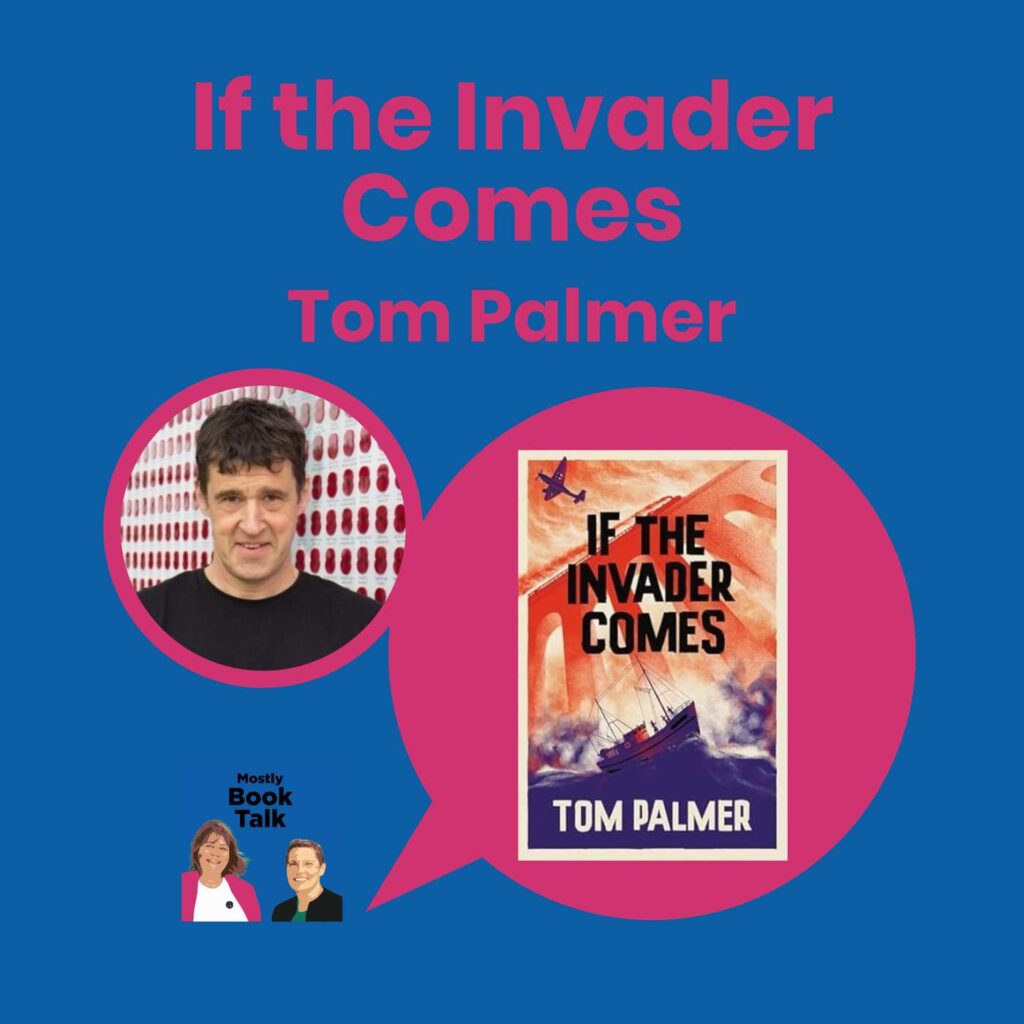
We talk with Tom Palmer about his latest book, If the Invader Comes, the first in a trilogy of books set in Cornwall. Published by Barrington Stoke in a dyslexia friendly format, the Allies trilogy explores the experiences of children during World War II in Cornwall and focus on the dynamics of friendship and allyship among the characters.
As with his earlier books about the two World Wars, Tom has meticulously researched the series and we talk about the records he has used of ordinary people’s lives in Cornwall during the war and the way in which he worked with a local primary school and has drawn on the knowledge of their extended families to ensure the stories are authentic. Having recently moved to Cornwall he has been exploring the county and as the National Year of Reading Ambassador for Cornwall Libraries, he has visited every public library in Cornwall to promote reading.
Tom is a familiar figure at the Imperial War Museum where he does a lot of his research. We talk about their current exhibition, Childhood in War, which explores how children have experienced conflict from 1914 to the present day and features Tom’s book Armistice Runner.
Tom also introduces his new sports series, Underdogs, which has a sports focus. The first one, The Fear, is about football; the second, Front Foot, about cricket; and cross country running is to feature in the next book.
We conclude with Tom’s own recommendation for a children’s book that shouldn’t be missed – Anthony McGowan’s Birdlands.
If you want to find out more about Tom’s school visits and the other events that he holds his website can be found here.
If you are interested in using Tom’s books in your school or library, free book club resources including questions and activiites are available at Book Clubs in Schools for both If the Invader Comes and Armistice Runner.
Katy
0:11
Hi, I'm Katy.
Ali
0:12
And I'm Ali.
Katy
0:13
And welcome to Mostly Book Talk. In this episode, we talk to Tom Palmer about his new book, If the Invader Comes. Which is his first book, isn't it? In a trilogy set in Cornwall.
Ali
0:24
Yeah. It's all around the Falmouth bit of Cornwall.
Katy
0:28
Yes. So it's very exciting. And it's we talked to him about the book and about his plans for the trilogy. He's well into writing. So enjoy that. So we're really pleased to have with us today Tom Palmer, who is Yorkshire raised, a super Leeds United fan. He is best known for his World War I and World War II novels, including the Young Quills Award winners After the War and Resist, and the Federation of Children Book Groups Children's Book Award winners, Armistice Runner and D-Day Dog. He also writes quite a lot about football and has a number of books that are about football and rugby. He is an ambassador for Book Clubs in Schools. We're very pleased to have him as one of our ambassadors. He recently moved to Cornwall and is now the National Year of Reading Ambassador for Cornwall Libraries. His latest book, If the Invader Comes, is the first book he's written since the move and is the opening title in a new Cornwall set, World War II trilogy called Allies. So welcome, Tom.
Tom
1:40
Thank you. Thank you very much for having him on and hello.
Ali
1:43
Hello. And you've written about the trenches and D-Day and the Holocaust and those Arctic convoys. And now you've moved to Cornwall, and this book is a new trilogy set there. And what's it been like moving to Cornwall after so long in Yorkshire?
Tom
1:58
It's been really nice. I think I like obviously I love Yorkshire, but moving somewhere new has been it's been really lovely for our lives. Like my wife and I and my daughter, it's it was the right time and it's the right place, and it's for various reasons with our family. It's good, it's really positive thing. Obviously, it's difficult leaving where I'm from and where my identity is from, but it's just so lovely here. And we find like the book world, the literacy world, has really supported and helped and been really an ally to us, which has been really wonderful. And I think I was talking to my wife about it this morning about moving here, and it's just somewhere completely new and somewhere different. It just gives you a whole new set of thoughts and things to write about, which is great. And that's why writing about Cornwall, sorry, there's a helicopter going on over.
Katy
2:51
It's normally me that's got a police helicopter hanging over my head because I'm right by the station.
Tom
2:56
But yeah, so it's been really good and really stimulating, and there's loads of new places and new things to understand. And for instance, like just living here, like sitting in the garden, there's much more nature. Um, and I'm sure with the book I'm writing now, I can see it. The book's got much more nature going on with it, and also like farming, like just and thinking in book three, I really want to put farming into it because living in a more rural area with farming is like a massive deal. You realise how damn hard they work and wanting to really reflect that in my story. So it's really stimulating and just refreshing. I get to go up and do school visits up north quite a lot, so I'm not missing it too much.
Katy
3:39
You get to go back, and presumably you get to go for the football as well. You mentioned about how generous the book community has been. Um, and presumably you're also doing lots of because you always meticulously research all of your books. Yeah. Has that also been welcoming in terms of local museums and libraries? And has that has that been different? How have you found that?
Tom
4:04
Amazing. I think because it's such a strong sense of place. Like before I wrote three books set up in Cumbria to do the first and second world war. And that bec I think once people realise that you're telling the story of their place, they really appreciate it and they're open, they open their arms, and they definitely did in Cumbria. But even more so down here, like the the the public libraries, the the archives are fantastic. People who own the big houses where D-Day and war-related stuff happened, the old airfields, places that are open as museums, have been really welcoming and wanting to help me do my research, and just because they want me to get it right. Because there is in a lot of children's literature, there is a lot of stuff about London and the South East, and obviously a lot happened in London and the South East, but it did also happen in Cumbria and and Cornwall. And they want museums and libraries and archives around here, want children in Cornwall to know what happened in the Second World War in Cornwall. And they do outreach stuff all the time and have people in. But if they can have novels set in their area in the southwest of England, that that's gonna really obviously it's gonna benefit them, but they it's part of their mission, isn't it? So they're helping me, and hopefully I'm helping them. And it does, there is a really strong sense of community and it's ace, particularly like the the public libraries, Cornwall libraries have been amazing and really, really helps me make connections down here to be able to make a living here because it was a risk. Moving to Cornwall was a risk because we didn't because I half our money, me and my wife, comes from doing school visits and half comes from the book sales. So I have to really hit the ground running here, otherwise, I'm gonna be on the M5, you know, every every Monday and Friday. And much as I love the M5.
Katy
5:53
Nobody loves the M5.
Tom
5:55
I love the M5. But it's it, yeah, it's really positive and it's really helps. I'm hoping that'll continue. So I'm still making lots of having meetings with people who have been really open to working with us.
Ali
6:07
Brilliant. Tell us a bit about the book about if the invader comes and the and Bobby, Caden, and Silla.
Tom
6:13
It's three books. It's called Allies, and it's about children who live in Cornwall and are from here during the Second World War. One is fully Cornish, one's half French, half Cornish because his dad's from fishermen stopped from Brittany, and one's half American, half half British. And it's it's called Allies because France, Britain, United States, and it's about how in the Second World War those those countries and many others, like the Commonwealth, work together to defeat Nazi Germany, and it's about how the war affects them and how they grow through it, because it's going to cover the whole war from the age of 11 to 16, 17 for those children. And it's yeah, it's I've been doing I've been doing loads of research, and it's I think it's paying off now because telling the story about someone whose mum and dad are gardeners, and telling the story of someone whose dad is a fisherman, you've got to you've got to find out what it was like for and farmers as well, what it was like for people in that time. So there's a there's an archive in Cornwall called Crescent Kurnow, which is just amazing. I was there yesterday, and they've got the the police diaries and the air raid records, and they've got testimony from people who worked in the hospitals and in and in all the other elements, and just reading and researching all of that means that I feel what is really important to me is to be authentic and not for people to say, Who's this person from Leeds writing a load of stuff about us? It's it's nonsense. So I've got to get my facts right, but on top of that, in writing that series about these children and their experience of the war, I've been working with a school down here called Milo Bridge Primary School in the same way I worked with Grassmere Primary up in Cumbria, and they're double checking stuff and checking with their families to make sure I'm not making up a load of utter nonsense. Obviously, it's fiction, but it's based on real stuff. And I can't just turn up here and write a load of nonsense because I won't going back to that, I won't be able to make a living in Cornwall as an author unless I do authentic stories.
Ali
8:16
And they're often stories, as you say, lots of it focus, lots of war stories focus on London and the South East. So it's kind of other people's stories that don't necessarily get told. And so it sounds like that archive has lots of stuff about real people and their experience.
Tom
8:31
Oh, it's amazing. How like, for instance, like the fishermen and how they worked with the SOE, the French fishermen in Brittany, and with Cornish fishermen here, and how they worked, like bringing back down pilots and all sorts of amazing stuff. Like in book three, there's I found out that this this French sort of spy came over on fishing boats with plans for the Atlantic Wall, so the defend the Nazi defences, and which really helped with D-Day. D-Day was obsessed partially because they had these plans which came across on fishing boats to Falmouth. And so, like really key events, really big stuff that that we don't know about happened here in Cornwall. Another one is after Dunkirk, there were still 8,000 British Army personnel left in France, and they walked all the way down through through sort of Calais and Normandy, and they they ended up coming across to Plymouth and Falmouth with refugees, and it was called Operation Aerial. And you never like most people don't, I've never heard of it, but it was a really big deal, and it was after Dunkirk, Dunkirk didn't rescue them all. Dunkirk was amazing, don't get me wrong. But Falmouth and Cornwall played a really important role late much later on, but you don't hear a peep about it, and that's a that's in if the invader comes.
Katy
9:50
And the invader comes, you've got the three children don't necessarily automatically trust one another, do they? Why did you come at it from that point of view? And as you said, they're from very different backgrounds.
Tom
10:04
I wanted different children, so one's very rich and posh and lives on her father's estate, but she's obsessed with aeroplanes because her mum was killed in an aviation accident when she was little. One's a fisherman's fisherman's son, and one's the gardener's daughter at the big posh house. So she has a natural dislike of the posh girl, but they end up coming together because of what their parents are doing. So their parents are doing something secret which relates to true events that happened in Cornwall, defending Cornwall and defending Britain's. And they're all they're different, but they come together. And I really wanted to have them as allies to French, British, American, because the more I read about it, the more. And I know the Americans came into the Second World War late, but when they came into it, they they were really important allies. And I think it's really important to reflect that history and show what our outstanding allies the Americans were to us and we were to the Americans during the Second World War, particularly now because of what's going on with Donald Trump, etc. Just that that history and that relationship must remain strong until he's not in power anymore. And so I'm thinking about now as well, and how allip is really important. And not and they're not just allies politically, they're these these children, they're allies in the playground as well. So the first time Scylla and Bobble, the two two of the three main characters, the first time they really realize they might like each other is when one of them stands up for the other quite unnecessarily and unexpectedly, which is what allies do, isn't it? Hopefully.
Ali
11:41
Yeah, and you don't necessarily you might believe that's right and you need to do that, even if you don't necessarily like that other person.
Tom
11:48
Exactly.
Ali
11:48
And how have the how's their dynamic how does it change? Because obviously in the first book, they're 11, 12, are they? Which I think. And then they're going up to 16, 17. So that's quite a big age jump in across three books.
Tom
12:03
Which I have to remember at all times, because you can quite easily forget that, as you can with your own children.
Ali
12:11
Oh, they've grown up. Oh, yeah. They're suddenly 17. Oops.
Tom
12:15
So one of the one of the characters I don't really need to worry about that too much. I'll just leave that one there. One one of the characters I need to work more on that. But the Scylla, who's the so she's the get, she's the half-American, her mom was like an American, a wealthy American woman who married a wealthy British landowner who needed that sort of a marriage. It was like a marriage with convenience. But her mum was killed in an aviation accident when Scylla was young, and so Scylla's obsessed with planes. So in book one, she's just really interested in planes, and there's an incident with a German pilot in the book. In book two, there was a factory in Tro, a secret factory that was repairing Spitfire parts in real life. So she's going to end up working there secretly without telling her dad. Um, and in book three, she's gonna be one of those one of those women who ends up ferrying planes from one airfield to another for the Royal Air Force, which was a big deal. And there's I've got a book about them.
Ali
13:15
And that again, like you say, it's a story no one's heard of.
Tom
13:18
Yeah, so there was like there was a lot, a lot of women because there wasn't enough men to fly the planes from get them to the right place. Women were doing that, they weren't in combat situations, but then sometimes they were forced to be in combat situations while ferrying a plane. So Scylla's gonna grow, but in book one, she goes to join the the cadets. I love that because she's a girl, and um and but in the end she does by book three, she's doing it, and she's really and she's an amazing, she's based on real people that I've read about, just like the others are, and she's just determined to do what she wants to do.
Katy
13:55
And there's something particular, isn't there, about wartime that puts responsibility on children because that they were the only ones there, or not necessarily the only ones there, but just out of necessity. So it allows you to get them to do things that yeah, yeah, that they couldn't do, yeah.
Ali
14:15
And is it worth um Tom? Because w I met you last week because at the Imperial War Museum, because there's an exhibition there, isn't there, that features one of your books and other books. Do you want to tell us a bit about that?
Tom
14:26
There's an exhibition called Childhood in War at the Imperial War Museum, and it's free and it's really good.
Ali
14:31
Is it on till Tom? When's it on till?
Tom
14:33
It's just started now, so it's probably until spring next year. I'm not sure. But it's so it's called Childhood in War, and it goes up to modern times and it's got things to do with Ukraine and with the Falklands and Afghanistan, and and it's about children's experience of war, and it's really accessible and it's not too troubling. And they've got within it, it's got they've got a book trail where you can search for six books. So Liz Kessler's When the World Was Ours and other books, and there's a Jacqueline Wilson book in it as well. I was so thrilled that they chose Armistice Runner as one of the books as part of the exhibition because all my books, all my history books, I start with the Imperial War Museum website and I research photographs and testimony. And I've the Imperial War Museum has been at the heart of all of my history books, giving me the confidence to write about history properly and authentically. And for them to use one of my books just is was the best feeling as an author. It was amazing. I can't believe it's saying it now.
Katy
15:31
I should have to go and check it out. I've just looked it up and it is on until February next year. Until the end of February. Just picking up back on that, the the having the children having that extra responsibility or just that involvement that they wouldn't necessarily have today, just because we're not in that situation, the position of being at war.
Tom
15:56
Yes. And the the freedom, because the parents are either not there or they're busy doing something else. And like my my father-in-law, who's just turned 90, he like he was a child in in the war. And I wonder what he should think about it. Yeah, and so he remain, you know, he remembers stuff, and his brothers certainly did remembered stuff that that went on like the absolute freedom that they had, and they ended up getting involved in all sorts of stuff. In particular, like one thing that happened here and in other farming areas was children, they had 10 days where they didn't have to go to school because they had to help bring the harvest in. And so, like, that's something I've been reading about. I've been reading a really good book about the land girls, and and they talk about how children were part of that and how the land girls used to compete with the children to harvest things quicker. It's just really funny, and I'll I'll put that in as a scene. And using real stuff. So, this this last week and a half, I've read about a German pilot, I've read about a land girl, and I've read about a girl who was 17 who worked in the local hospital in Tro. And their stories help because when they talk about children and how free they were during the war, that really helps me get my facts right as well. And I do obviously I do make stuff up as well, but it's always quite fair enough. This based in stuff.
Katy
17:19
And having moved to Cornwall you and writing about it, the place itself has become part of the books. How's that been? And do you find yourself walking around thinking, oh, that's like that?
Tom
17:31
And I do. It's and it's great. Obviously, you've got the beach and the sea and the cliffs, and but you've and you've got all that, and it's what most people see at Cornwall, but the the weather, it's great because it's like you'll have massive mists. When we moved down here, there's lots of heavy mists where you couldn't see along the road to drive, and but you've got storms and you've got wind and you've got rain. And I'm really making a I wrote down today, check each chapter to determine what the weather's going to be like, and not just have it sunny or not mention the weather, because the weather is a part of Cornwall in particular, like it was in the Pennines where where I used to live before. But what one thing I'm doing is I've got a notebook which is specifically the next book is called Go Warily After Dark, which is a poster they used to have in the blackout. So at least half the chapters are set in the dark, in the blackout, or in the city, or in the countryside. So for August, I'm going around walking around in the dark, often in the countryside with my dog and recording what like what I see, but also what I hear, smell, etc. etc. Because I want to describe the dark properly. And I'm going to go out and camp in places and go and sit on a beach. And I'm going to walk around Tro a lot in the dark in quite early morning rather than late at night, because I think it'll be quieter, just to get descriptions to do research. And that's like when I used to do the Cumbria books, like what it was like halfway up a fellow by a lake in the middle of the night. It's the same here, and just gathering observations and descriptions so that I can get it right. And just doing things that I've not really done, like the book I'm writing now, is set partly in Roscoff in Brittany. So I'm going over there for a second time to do research and all those sorts of things that I expose myself to the places. It means hopefully my descriptions will be better. And definitely the nature down here. I think there's a breadth of like birds and other mammals that you see, which it because it's more rural, and that's where my book is set in a more rural area. That's really helping me. Like other than not other than making up a load of cliches that might be based on other books I've read or cartoons or something, just to be sure that my research is it's going back to a primary source, isn't it? It's because you can describe stuff based on cliche and received wisdom that you've not actually experienced yourself, and it's better to experience it yourself.
Ali
19:59
And and also you know that being out in the dark, it's not as dark as you think it is.
Tom
20:05
Exactly. Yeah.
Katy
20:06
I keep thinking your dog's gonna be very confused. It's like, why are we now doing walks in the dark?
Tom
20:12
But like I've been reading that, it's called John Lewis Stempel, I think. He writes about nature and he's written two books about night walking. He's just amazing. He's won the Wainwright prize a couple of times. I think he's really amazing he's a farmer as well, and he writes amazingly about nature. I've read two of his night walking books, and he talks about that it's not dark. Once your eyes are used to it and there's not you don't have a torch and headlights near you, it's often it's like quite bright and you can see your way. And so I need and I need to do that. And I've written down in my diary when the full moons are and all that sort of stuff, just to find ways of describing the dark better. Because I want I kind of want to do a book because it's called Go Warily After Dark. I want to really play on because of because it's about the blackout and it's about Britain being under siege, so at night everything had to be black. So it's I'm hoping that doing that will give me more descriptions to make it a bit richer.
Ali
21:12
And w and will all those descriptions will that all be in the countryside, those dark scenes, or will there be some city scenes as well?
Tom
21:18
There'll be city scenes as well, so true, a lot of it's set in Truro. There's a horrible scene. Like on the 4th of August 1942, Truro Royal Infirmary got bombed and nine people were killed in the hospital, and it was just as the sun was going down, so it was mayhem and it was chaos, and it was absolutely horrible. And that's the key bit of the story. So I'm gonna go, I think I'm gonna go about oh like four in the morning and just walk around Troro before it gets light. So I think if you do it at night, if you do it at ten, eleven at night, then you've got there are people around, aren't there?
Ali
21:51
So there's quite a lot of pubs in Troro.
Tom
21:52
So they're and they'd get distracted.
Ali
21:56
You'd get get called into a pub and miss all your research.
Katy
22:00
How much has the countryside changed, do you think, since the wartime? Is that I don't know. My kind of limited knowledge would say, are the fields, are there fewer hedgerows, are the fields bigger, or is there just I don't know.
Tom
22:13
From what I've read and researched, farming changed dramatically in the 1950s, and it went from much more mass mass production. I don't know. I've read a bit, but what I do know is like more things like fertilizer and other things like that and insecticides were being used. So in the 50s and 60s and 70s, it got more and more denuded, really. And fields did become bigger. Like here, I don't know, less less so from the Luffy. But I was driving in Wiltshire, the fields are like massive, they just go on for miles. I think here it's a much still much more of a patchwork, but it's definitely changed, and I have to be aware of that. And I'm really lucky there was there was a photographer who was in Cornwall, so in the 30s and 40s, called George Ellis, and he took 95,000 photographs, often of rural rural situations, and I can access them through Crescent Kerner, the archive. So I've been just looking at those photographs. And similarly, there was a similar photographer in in Cumbria, and it's just not making the mistakes, and like roads, like motorised vehicles, there was far fewer motorised vehicles then. And because there was no petrol, there was even fewer. So you've got to get all, and so a lot of the farming would have been done using horses and etc. etc. But by reading stuff set then, and or memoirs set then, you're aware of it, you're more conscious of it, and you're less likely to make mistakes. And then I've got Ailsa Bathgate, my editor, who's like forensically seems to research every statement I make. And she's got fishermen in her family in the past, so that all really helps as well.
Ali
23:53
And it's another Barrington State title, isn't it? So it's dyslexia-friendly, tinted paper, all and tightly paced. And I know you've talked a lot in the past about someone who was a reluctant reader and you got into reading through match day kind of reports and things. Yeah. Is how writing with that format does that change how you tell a story because of the kind of compactness of it?
Tom
24:16
No, not not for me, to be honest. No, because that naturally how I write. Because I can't read, I don't read long books. I really struggle with long books. And so when I write, I do fast-paced action with cliffhangers, and and obviously it's got its depth and its shades to it, but it's for me, I feel like that's how I would write anyway. And probably a lot over the years since I've been writing for them for 12 years or something now, I must have picked up what they want as a publisher, but also what whenever I write a paragraph, I'm thinking, I should well like that. I'm thinking like, because I'm in the book I'm writing now, I'm experimenting with having the children going around their Cornwall business. But every sort of second chapter I've got a one or two page bit from the point of view of a German pilot who's doing nasty things in Cornwall. And it's really interesting to be in his head and then be in the children's head. And but I and it's not working that well. And I think I'm gonna keep it in and see what Ailsa says as an editor, but I think she's I think it's too confusing. I think it really have it suddenly going into the head of someone several hundred metres up in the sky, it's too confusing. But I'm gonna try really hard, but I'm aware of how Ailsa wants me to write, and I'm very respectful of that because since Ailsa has been my editor, I've won those all those book awards and made a living out of being a writer wizard before I didn't win any, and it was looking a bit difficult making a living doing it. Now, when I talk to children in schools, I say, I talk about editing, and I say, Who's got a coach, who's got a dance coach, or a football coach, or a rugby coach, or a running coach, and they they tell you what you're good at and they tell you what your weaknesses are and they make you a better runner or dancer, and then even when you get really good at it, the best sports people, they've got coaches tweaking their style and improving them and making them into better sports people, and that's what an editor does, even though I've published all these books. I'm still getting coached very, very heavily by an editor who's and I talk to children about that because they need if they can see it as even though you feel like you've done it, you could get better, you could be faster, you could win more trophies. I don't know, it's a bit like that.
Katy
26:38
You did the If the Invader Comes, you mentioned that you were working with a primary school in Cornwall. How is so how have they reacted to the book? And how is talking to the kids about the book, particularly when you go into Cornwall schools, about it?
Tom
26:53
It's been really good. I've been into quite a few Cornwall schools now, and it's been really lovely talking about it. And for me, I I when I'm doing a school, I was trying I don't know, I just feel embarrassed just standing there talking at them. So I'm trying to make it more interactive. So I've done a quiz of 10 10 questions about what happened in Cornwall during the Second World War with an ABC option. So I start with that and I've engaged in and telling them how important it is, what Cornwall's role was in the Second World War. And so that's been my way of doing it, and they've responded really well to that. It's gone really well. And the children that I actually wrote the book with, they're really pleased that I've listened to them and the stories they've gleaned from their families. Um and I think, yeah, we had a launch, and like I gave them all a copy of the book and said thank you, and their names are all in the back, and they know they've contributed to it. And that's a really positive thing, isn't it? It's not like I'm and I'm talking about them, I'm talking about the people I've met and interviewed, I'm talking about my editor, it's it's a collaboration of lots of people telling us stories. The idea of one writer sitting on their own in a shed or something like that, or a garret, it's unless you're a genius and like really stubborn, it is a collaborative thing where you need the help of lots of people.
Katy
28:13
Yeah. No, I think it's interesting. I like the idea that you're there's sort of all of these stories and conversations have rippled out from you starting that with the kids, and they've gone and talked to their parents, and they may not have known that much, but they may have thought about what their parents have said to them, and then if they're still around, and then what their parents have said, because it goes back quite away, doesn't it?
Tom
28:35
It does. And the story is like I've read 20, 20, 25 local history books, because there's nothing really about Cornwall in the national history books about the Second World War. And this the stuff I've I've found out that happened in Cornwall, like that Operation Ariel that I mentioned earlier, that like I've met two people who knew about it out of 5,000, like in Cornwall. And because we don't if we're using national resources and national books, we don't find out about what happened in our areas. And that's and I learned that from Cumbria. I learned that you can if you engage with a community to write your book, it it makes it authentic and if and the readers will feel more like it belongs to them. Validates where they're from and the and to be proud of where they're from.
Katy
29:23
Yeah, and and it may prompt other kids from different bits of the country to think, oh, I wonder what happened here.
Tom
29:28
Yeah.
Katy
29:29
Yeah.
Ali
29:30
Exactly. And you're the National Year of Reading Ambassador for Cornwall Libraries. What's that role actually involved day to day and what you're hoping to get out into schools and libraries?
Tom
29:41
It's like as and when. So I like they've got their summer reading challenge, and which is different to the national one, and I've helped promote that. And I've done videos. I've got oh yeah, I've gone on Radio Cornwall for them a couple of times to promote libraries. But the main thing we did first is during half-term, like in May or whenever it was, May, June. I went to every there's 28 libraries in Cornwall, and we went to them all over a period of that half-term and a couple of days. That's a lot of driving for a day. But like Andy from the libraries, he drove me. We did mostly public events, but some school events, and we hit every library because we wanted to do every library. And obviously, that's great for the libraries, and I did it for free, but it meant that I could go to every library in the county in a really tight amount of time. Only just moved here and promote my book about Cornwall. And it's bound to have a ripple effect in bookings. It already it's already started, like getting bookings and so stuff. Anything that wants that they want me to do, I'll support. And but then I am getting some paid work from it now, increasingly. So it's and it's a mutual thing, and we just sit down over a pasty, literally, and we discuss how we can work together.
Ali
30:54
Very good. If you've got a library, if you've got your Cornish library card then, Tom.
Tom
30:58
Oh yeah.
Katy
31:00
I'm really impressed.
Ali
31:01
And Cornwall's quite a big geographic area.
Tom
31:04
But it's and I now I've been to like all I've been around, I know the county a lot better, and I know the different sorts of places, and there's really different sorts of places from St. Maws. I was in Red Ruth yesterday, having a meeting with this charity that puts stuff into schools, and there's Red Ruth is has its troubles, but and there's a lot of poverty in Red Ruth, but they're so passionate about finding a way of improving the opportunities for children in Red Ruth, and it's awesome. As is going to like one of the like sort of the really nice posh places where you can have a coffee on the beach and all that.
Katy
31:40
So we've heard rumours that there might be another Barrington Stokes series coming up. Are you allowed to talk about it?
Tom
31:47
I am, yes. Like Barrington Stoke, I love them and they're wonderful, and they've been so supportive and kind to me. The reason I'm living in Cornwall is because they let they said yes to me writing a Cornish trilogy. We couldn't, without that series, we couldn't have lived in Cornwall. So I am devoted and loyal to Barrington Stoke. And they've asked me to do a sports series. The first one's out and it's called The Fear. And it's about a foot a boy who's a footballer. Then book two is called Front Foot, and that's about a cricketer. And book three is probably going to be called something else. We've not just got to be. You've got to do rugby.
Katy
32:28
You're going to do rugby? Oh, okay. I've got I've seen The Fear, I've got The Fear somewhere. That's why I was looking behind me. I didn't realise it was this it was a new series, so that's so exciting.
Tom
32:38
So it's called the underdogs, and it's based in in Derbyshire, actually, which is where my friend's ahead teacher in Derbyshire. And it's a really tough area, and there's a lot of poverty and crime and drugs and difficulties, and it's about these these three children who are underdogs and they don't they might not get the opportunities, but they're in a place where the community is really trying to help them through sport. And the second one, which is out soon, is called Front Foot. And it's about so you know the translators in Afghanistan for the British Army who were promised they could come and live over here if it all went wrong, which it did really, didn't it? He's so the boy is a cricketer whose dad was one of those translators, so it's about them coming to live in this country, but his wife and sister are still in a refugee camp in Pakistan, and it's about what the British Army owed to those translators, and then how coming here that boy wants to live his dad's dreams of being a cricketer, so it ends up with them playing in a match at Trent Bridge. And there's not much cricket fiction about for children, really. To be honest, it's persuading publishers to do cricket fiction is really hard. Really hard. And like rugby was hard enough as well, because it's all football, isn't it? So I'm really so the second one's cricket, the third one's cross-country running as opposed to fell running. It's more like a cross-country running. But they're all three mates and they're all featuring each other.
Ali
33:59
Oh nice. So it's a little world set in Derbyshire.
Tom
34:02
It is, and they're super short. They're I think like they're like 6,000 words long or something, but they look because it's Barrington Stoke, they look longer and it's on the off on the off-white paper, and it's been edited beautifully again. I feel I've really enjoyed doing them because they're a lot shorter than the the history ones I do are 25,000 words long. It's been nice. And the third one, the running one, which is coming out next year or something, is it's just a race. So it's like from the start line to the finish line, and it's a race, and it's but it's like what you think about when you're racing, you think about people you don't like who you're racing against, and it's all so it's like real times, it's set in real time. Yeah, exactly. Yeah, wow. Which was fun to do and like challenging, but we with the help of Ailsa, the editor, it's gonna be alright, I hope.
Katy
34:51
Oh, that's I like that. That's interesting content.
Ali
34:54
Yeah. So our last question, Tom, is have you read anything recently that you think's gone under the radar, or you think we everyone should be reading as well as your books?
Tom
35:06
Yeah, and like I've read lots, I've read lots to do with history and the war, but like children's book, the one that's jumped into my head is Birdlands by Anthony McGowan, who, although he was born in Manchester, but he was brought up in Leeds, and he is a spectacular writer, he's one of our great assets as a children's author. He writes so spectacular about nature. So Birdlands is about this this group of three birds, basically, who go on an adventure. And I I can't put it into words, but he can, and he's just really good, and I just love the way he gets pigeons and rooks and the like. He just really gets it.
Ali
35:44
His book, Dogs of the Deadlands, yeah, was amazing that it was set in Chernobyl.
Tom
35:49
So this is about birds, yeah, and it's great, and it's just been shortlisted for the Wayne Wright Children's Book Award, which they're now doing, which is really good. And I don't doubt that he'll win it because he's a proper prize-winning superstar, isn't he? And but he's great, and he's just such a good writer, and there's simple stories in there, they're beautifully written, but not intimidatingly beautifully written. He's just brilliant. So that's what I'd recommend. Birdland.
Ali
36:16
Very good recommendation. Thank you very much. Brilliant. Thank you. Thank you so much for talking to us. And we got a little bit of the sounds of the nature and the helicopter.
Katy
36:25
Helicopter and bird. We had a bird. There was definitely a bird in there.
Tom
36:30
Yeah.
Katy
36:31
No, we didn't get any sheep, but we definitely had a bird in there. So we hope you've enjoyed that. You you may have heard about the news story in the at the beginning of when was it? Beginning of September?
Ali
36:46
No, sort of the end of September of Second World War American bomb was discovered in Falmouth, which involved clearing the whole area and people, the new students also turfed out of their um student accommodation. Just after I'd been there, actually. Oh, okay.
Katy
37:03
So between you and Tom, it was some kind of big publicity slunt. So it does feel a bit extreme for a publicity stunt to launch a book. But that was the yeah, to launch if the invader comes. Anyway, top recommendation. We also have a book guide for it on book clubs and schools. So if you want to use it with your book club, there is a week by week guide there for you to use the