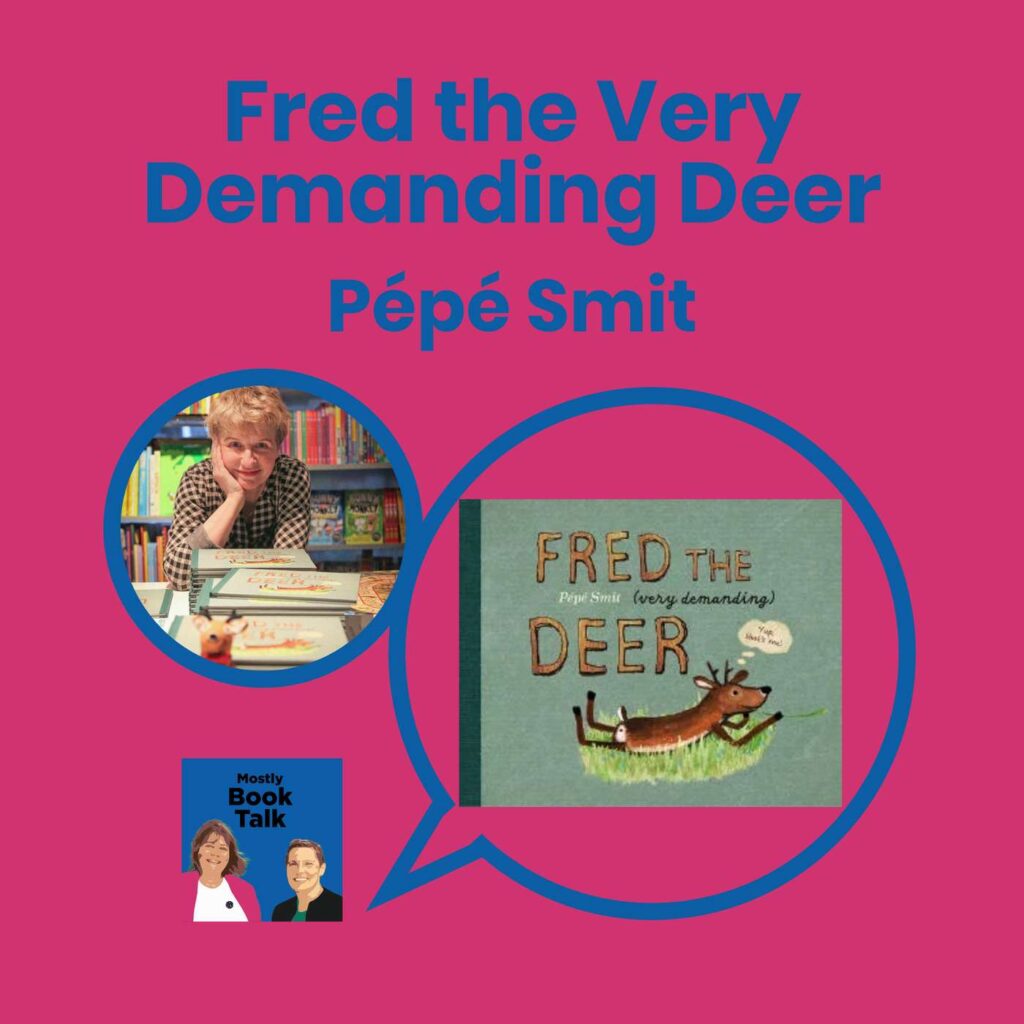
In this episode we talk with Pépé Smit about her picture book Fred the Very Demanding Deer which is published by Scallywag Press and translated from Dutch. We were lucky enough to go to the launch at GOSH comics and met Pépé, loved the book and of course wanted to chat to her about the book and Fred.
Pépé trained as a visual artist at the Gerrit Rietveld Academy and the Sandberg Institute. Her illustrations have appeared in several leading magazines and newspapers, but she has increasingly focused on creating picture books that make young children both laugh and think.
Fred the Very Demanding Deer is a story about a deer who wants to leave the forest to visit the city – his adventure breaks the fourth wall and is a chat between the illustrator and the deer as they navigate the trip and the book together. We talk to Pépé about how the idea for the book was developed and how it grew into a series (there are many more books in the series) and the translation process from Dutch to English.
Win a copy of the book and a felt Fred!
We also have a very special giveaway of a copy of the book and a felt Fred which would be a lovely addition to a Christmas tree – (UK only) This giveaway is running on Instagram, entrants will need to like the post announcing the competition, comment on the post and follow Mostly Book Talk.
Instagram: @mostlybooktalk
Full Terms and Conditions can be found here.
Katy
0:12
Hi, I'm Katy.
Ali
0:13
Hi, I'm Ali,
Katy
0:14
and welcome to Mostly Book Talk.
Ali
0:16
In this episode, we talk to Pepe Smit, who is a pitch book illustrator and author based in the Netherlands, about her book Fred the Very Demanding Deer. Lovely. Enjoy. We're delighted to be joined by Dutch illustrator and author Pepe Smit. Published by Sarah Pakenham and Scallywag Press. The first picture book to come out in English by her, though she's had 10 published, is Fred the Very Demanding Deer. So welcome, Pepe. Tell us a bit about Fred, the Very Demanding Deer, as he's very new to English readers, but he's not necessarily to Dutch ones, is he?
Pépé
1:00
Hi. No, he's not necessarily to Dutch ones because I've made 10 other books about him and maybe two about other animals, but 10 books about of eight books about Fred, and he has a very hardcore fan base. Who some of them are already 10 and they still want uh Freds for their birthday, so I'm very happy with that. But he's new to the English speaking audience. So uh this is the first book about Fred, and Fred is not necessarily the nicest, friendliest, or well-behaved main character in the children's book world that might be, I think, part of his success, especially with children who recognize uh uh something rebellious in him. He's a deer, and it all starts out as you would expect with a deer in in a wood living there, how deer live. The thing is, animals in my books, also in the other books, are always uh real animals. So there's not dressed up humans dressed up as animals, but they're animals, so they eat grass, leaves, they don't live in burrows with furniture. They live Fred sleeps on the ground, on the bare ground, under his okay, favorite tree, but still under a tree, which is as animals do in real life. So they're they're not playing, they're not human beings playing to be an animal, they're actually animals, even though they do want things that real animals might not want in reality.
Katy
2:38
So and Fred has quite a lot of demands, doesn't he?
Pépé
2:42
Yes, he does, but it's that's not because he wants to be so demanding to start with, but I think it's because somebody is dictating literally what he is going to do. So that great dictator would be me telling him you're going to you're going in the woods, you're living in the woods, you're very happy, you're eating this, you're eating that. And that sort of makes him feel cornered, I guess. And that's why he starts demanding. It's a bit his rebellious character, more than that he wants to be demanding. He just wants to be that because he doesn't necessarily want to do what is laid out for him. So it's it's more that than him being, yeah, demanding in a negative way. It's more like, no, I don't, maybe I don't want that. How about that writer?
Ali
3:38
You know, and then it's that conversation between you both, which I think is really is kind of sweet and endearing in that he's like, No, I'm not doing this. And then you're like, Okay, maybe you can have some hands.
Pépé
3:51
Yeah, it's a bit of a battle of wills, and me, the writer, is also questioning her own role in a way, because yeah, well, this all sounds complicated, it's it's very simple, and and small children really get it, I think. Also, this meta idea of breaking through the fourth wall, I think you call it, yeah, where I take the reader into what making a story really is. So it's a book about a deer, but it's also a book about what is a story, and what can you do in a story? Everything? Fred thinks everything, and I'm more like, well, that's a bit bold, but the more he demands, the more I ask myself, well, why not? And in the end, Fred will or halfway Fred will say, But this is a story, so why can't you give me hands? Which is a rather bold demand. This is a story, so it's a story, so you can do anything you want. If you write, I want this to happen, you can make it happen, and then I think, yeah, he's right, you know. Well, I want it, I can, I probably could. So it's asking about what a story is, and I think children like that. I also I go to schools and read the book, but then afterwards I do a workshop which is how to make a story, and children are uh at least I hope so, but it often happens that they're inspired by this story to make their own story. I give them an assignment in which I show one page where Fred is jumping out of the wood, and in the book he's going to the city, but then I show a page where nothing happens, and then I show a page, and that could be anything a teacher or a uh a grown-up could think of. Another situation, in this case, it's Fred is on the moon, and then I ask the children, but what happened in between? You know, where's that? What happened on this missing page? Can it's gone? Can you draw it for me? Can you make it up? Can you imagine how he got there? And I'll tell you one thing, it's not with a rack, uh rocket. Yeah, it's something not really possible in reality, only in a book. So then they have to imagine and draw, and even three or four years old, four-year-olds come up with yeah, sometimes you can't really see what it is, but then you ask them, and then they go, Oh, this is a trampoline, and there he jumps on a star. It's just lines, and because they're technically not able yet to visualize this, but they have the ideas, yeah. So I think it's nice. I feel sometimes children are emotionally more intelligent than we think, and you can also, if it comes to imagination, and you set them on the right path, they can really go wild. I love to see that. So I really hope with my book that I encourage them to use their own imagination more.
Katy
7:01
Yeah.
Pépé
7:02
So apart from telling them a nice story.
Katy
7:05
They've got nine more in the series. So in in this one, Fred goes to the city and experiences the city. And a mixed experience, doesn't he? Yes. What kind of things happen in the the other nine books? Is it similar that he wants to go somewhere?
Pépé
7:20
It's well, the whole thing with the the dialogue with his creator, me, that does not come back because that was a a one-time thing for his. That's when he was created. After that, he just exists and he keeps his hands, as you can read in the book at the end. He lets his go of his shoes, but he wants to keep his hands, especially because they're very handy for nose picking.
Ali
7:46
Yeah, we saw that.
Pépé
7:47
Imagine having hooves and all kinds of things you want to do, you can't do anymore. So once you're used to them, obviously you don't want to give them back. But so he lives in the wood with his friend Rabbit, and most adventures happen there until he sort of one time he got he wants to go to school. That is called Fred wants to go to school too. He meets a lost girl who is in the wood and lost the school bus. Uh, they went on on a school holiday with the bus and she got lost, and then he takes her back to the bus. But once she tells him that in school you can learn everything about everything, he is so enchanted by this idea that he wants to go to school too. And then she lends him her jacket so he can put the capuchon over his antlers, and he looks like as if one kid is sick and he looks like he has a cold. At least the teacher who has very thick glasses and is not very good at spotting things, obviously, thinks that it's just one of the kids with a cold, and in class he finds out that one and one is two, and he thinks that is everything, and then he jumps out of the window and goes back and tells all the animals that one and one is two, which is everything. But in the end, he sort of finds out that it's information that doesn't bring him anything, because if one and one apple is two apples, but shouldn't you just eat apples? He finds out that school is not for him. I think children think that's very funny.
Ali
9:28
Yeah, and I think it's that kind of just trying things once and then going, actually, no, thank you. Yeah, not now. Which uh for children, it's no, you've got to go again tomorrow, you've got to keep going.
Pépé
9:40
Yeah, yeah. I think also that that Fred sort of gives children a voice in children, are all the time they have to dance along with what grown-ups want to do, and maybe that's a weird expression I just made up, but they're being told all the time what to do, and often they feel yeah, in not empowered in what they want, although kids today probably much more than when I was young, but still you have to in the end, you have to do what the grown-ups uh think is best, right? Go to school, for instance. Yeah, you have to. And I think I often hear that how you call them HDHD, ADHD, yeah, like me, kids. I have that too a little, really pay attention to these books and uh very engaged also in the assignments, and like from teachers, I often hear, wow, these and these kids, they're always it's they don't pay attention if you're reading, or they find it hard to hear this longer than five minutes, and your book they just listen to the whole book, and I think that's because they sort of feel they recognize themselves in Fred, so they're it's easier for them to keep paying attention. That's interesting.
Ali
10:57
So, how did the translation come about?
Pépé
11:01
Well, that I was really, really thrilled that Scallywag, Sarah Pakenham, wanted to translate my book. And then the thing was like, How are we going to translate it? And she said, Well, I have somebody with the what's it called again? A publishing house. How do you call that? Um the publishing house, yeah. Yeah. Okay. We have somebody, uh a friend of hers who really would like to translate this, and this was part of why she fell for the book in the first place, because she thought, oh, my friend will love this book and will love to translate it. And then she came with the translation. Also, she was half South African and understood Dutch, so she could read it, and she made a sort of a first layout for the translation, and then on the phone in a Zoom of like four very exhausting Zoom for four hours, but but very good. We went through every sentence. It would be like my suggestion should be more like Fred wouldn't say it like that, perhaps. I know it, I know what you mean, and you translated it correctly, but it's not in his spirit. So I was more there to keep Fred's spirit alive in the language, and she, Janice Thompson, who translated it, was very yeah, sensitive to picking that up and making suggestions about well, maybe like this then, or maybe like that. And for instance, one of the hardest things was actually the title, because in Dutch, Fred is called eigenwijs, which means own song. Fred sings his own song, and that if you translate if you ask Google to trans or whatever, to translate eigenwijs, they will come up with stubborn, headstrong, things like that. And it's not correct because it's much more fun than that.
Ali
13:07
Because yeah, that's too strong, isn't it? The stubborn is too strong.
Pépé
13:12
Negative. Yeah, as you can hear, cheery and and nice, nice association, so not so negative, actually, quite positive. So there was that word does not exist in English. I found that because I've asked a million people, and nobody came up with the right thing, and also not the translator, because we had all sorts of ideas, and then they came up with let's not try to literally translate that, but let's try something completely different. And then she came up with demanding. And at first, I thought, well, maybe that is also a bit negative compared to yeah, things the same song. But in the end, I thought it did bring out something in Fred that is already in his character, and that is now more emphasized by this title, and that is this demanding side. And I do like that a main character is not sweet, is not only friendly, and wants to share. And Fred is demanding, which and I like that it's it's different, it's different, isn't it?
Ali
14:26
But it's still in keeping. I was trying to, I'm I'm racking my brain now to try and think of a translation for it. And it's a bit like you know, the song Frank Sinatra, my way. I did it my way.
Pépé
14:38
A bit like that. I didn't do it my way. Yeah, yeah. That would have been funny, too.
Katy
14:43
I did really like the bit in the book where you at the beginning, where you're as the author and illustrator, you're drawing Fred in different ways, and first he's too small, he's now far too small, and then far too big. Yeah, too cute. That he didn't like being cute, did he? Yeah, he's not cute. He's not a cute deer. He's a proper sensible deer.
Pépé
15:03
Yeah. That came to my mind because at the time I was making it, it was a New Year's Eve, actually. The first time I drew him, I was jet-legged and came from a party and yeah, thought of this story, and he started talking back to me, probably partly due to the jet lag and god knows what. But anyway, around Christmas, there were so many cute deer. It was sort of sickening because I have a cabin in the woods and I've seen quite a lot of deer, and even one standing on my doorstep, once barking at me and being very impressive and not at all cute, stamping his hoofs and going. Honestly, they do that. And then I thought, like, well, deer are often seen upon as so cute and sweet and lovely animals, and they're really not like that. So wouldn't it be nice to have a more real deer-like deer in a book?
Ali
16:01
Yeah, the one where he's where he's cute, he looks a little bit like the baby sham deer.
Pépé
16:06
So he looks like Bambi.
Katy
16:07
Yeah, yeah.
Pépé
16:08
Probably.
Katy
16:09
Yeah, I was gonna say it's been like Disney Fied. Deer have been so Disney -fied, haven't they? They're these cute little things that bounce around with white fluffy tails.
Ali
16:16
Um and we yeah, we I live quite near Richmond Park where there's a lot of deer. And there's there's quite often lots of signs saying under no circumstances at this time and this time go anywhere near the deer. Right, right. Because they've got massive antlers and they protect their space.
Pépé
16:34
Yeah, French is a bit of a young deer, and they're often thrown out of the group and then walk around bad with bad behavior, like teenagers, teenage boys. You could say uh that they're making mischief in the woods, they really are. And until they get their own, I don't know, what's the bird or something? Yeah, their own female group. But until that time, which is around two or three year old, I think I'm not a deer specialist, but it it Fred is dead thrown out of the group, wandering around making mischief, kind of young, boyish deer. A young book.
Katy
17:14
Yeah. And do you get urban deer? Do you get deer in your cities?
Pépé
17:19
And at some places we do. They can be a bit of a nuisance because the same with wild pigs. Oh, interesting. Yeah, not everybody's crazy about them.
Katy
17:28
Yeah, so we we we get lots of foxes, so ridiculously, you're probably more likely to see a fox in London than you are in the countryside in the UK because they're just everywhere. I mean, I never go home in an evening without seeing two or three foxes wandering around. Wonderful animals. Yeah, they just they do seem to be everywhere. What have you noticed in the process in terms of being coming into the English picture book world? Are there differences in terms of the the way in which what our picture books are like? Have you noticed any of that?
Pépé
18:01
Or yes, I think British, not that I've read so many, but I do get the impression they're more funny. And also, I think that Fred, Fred's start-off here in Holland was people really had to get used to this. There's some people immediately liked it, but that was just a small group, actually. And many people, also many children's book writers, were a bit like, what is this? And also this whole meta thing that was children wouldn't understand that. And and also because I come from an artist's background and not from a writer's background, yeah. Maybe that made it a bit like, oh, this is an art book or something. And it isn't really, it is also if you want to, but it's also not, it has many layers, and you can choose if there's also a layer for everybody, and if you want to, you can find other things, but or jokes for grown-ups, for instance, but never over at the cost of what small children could appreciate. So um, yeah, I it it was easier. We went to some bookstores, and young bookselling women would come up to me, or men also, and say, Oh, you're from that book. I love that book, and I really felt like, oh wow, they really get it here. So that was it was probably better than my than the first years with Fred in the Netherlands.
Ali
19:36
And and how long how long did the process take from kind of Sarah saying, Oh, we want to publish the book to it appearing?
Pépé
19:46
Ah, I I'm not quite sure, but it I think about a year. Well, not that long. It can take ages, but this went rather fast. And also, I was really happy with the fact that they wanted a hardcover, which in the Netherlands is regular, but apparently the British prefer uh sort of a soft cover because it's easier to store and cheaper, probably. But they said no, we're gonna do uh a hardcover with uh line and backing. So to get the really old-fashioned feeling, which suits the book very well because that has a sort of yeah, maybe nostalgic little bit, feel about it.
Katy
20:28
Yeah, most mappage books are a standard 32 pages, and it's longer than that, isn't it?
Pépé
20:33
Yeah, but that was something my own publisher is was the first thing he said, it's too long. You should know it's has to be 32 pages because that's much easier to print. And then I said, Okay, so you want me to take something such as well, don't we'll we'll take it like it is, because we really like it.
Ali
20:54
So is it 36? Is it 36 then or yeah, 36? Yeah, I know it's not a map, you don't think it's a massive difference, but for printing it is because it's a whole other little section.
Pépé
21:05
Yeah, yeah, yeah. There is one other funny detail about or detail thing about the book in English, it has a different ending. Uh oh. That came about that was funny because that was actually a mistake that turned out well, because at first the publisher had sent to Sarah my first draft that had a different ending, because that ends with Fred picking his nose and all the animals laughing about it and saying, Oh, I wish I could do that, and oh, he's you know, he's the hero of they're not really laughing at it, he's a hero because he can do something none of them can do, except maybe a martyr or something. They have fingers. Uh so that's the joke it originally ended with, but my publisher felt something else there had to be something more so. Two of the it was 34, but two of the pages came even were even added to it because in my in the Dutch version he falls asleep and sucks his thump and then he says and he's really tired of everything and in the end he even has a thump to suck on and nobody tells him not to. So but because they sent him they send it the original one with my own ending before it was altered to for my Dutch publisher, and they really liked it, and then they said, like, oh uh we mistakenly sent you the wrong one, and so they sent the one that as it was printed in the Netherlands, and then uh Sarah said that I like the other one better. And so that was funny because it's it it's there is a real difference not only in the translation but also in the pictures, yeah.
Ali
22:52
So uh so it's a it's so it exists, yeah, so it exists as its own edition rather than a translation, effectively.
Katy
22:59
A bit, yeah, yeah. And did any of the pictures change? Did you have to do any of the any?
Pépé
23:06
I had to emphasize the end more, and also this gave me the opportunity to put in some characters uh that uh show up in later in later books. Okay. When I made the first one, of course, I didn't know who was going to live in the forest later on, but so I could um take them to the front, so to speak, in time. Like his best friend Rabbit, who only shows up in the second book and later on becomes more and more important. He is also on that page already.
Katy
23:37
So he's going back and looking.
Pépé
23:40
Doesn't matter, but it doesn't matter, but he's here, isn't he? Yeah, yeah. Nice. Oh, nice. So that was fun to do. Yeah. Oh, and I had to change the chips and to make them less fritz. To not to to not make it a Dutch boot, how's boots? I don't know. Wagon.
Ali
24:01
Was it like a club before?
Pépé
24:03
No, no, but it was on Dutch saying it didn't say fries and and drinks. It's uh something Dutch, obviously.
Katy
24:13
Something Dutch, it's yeah. That's interesting. You you launched it here. Have you been and you said you've been around bookshops? How's that been?
Pépé
24:22
That was wonderful because they were so enthusiastic. I really I did not look forward to that because I said, What are we gonna do then? People don't know me, I'm new. If I go here in the Netherlands, I go to a bookstore, I have to sell, oh, I'm from Fred the Deer, and uh thank you for selling my book. If I see it lying around, or otherwise I say, maybe you want to sell my book, and they're always like, Oh, yeah, well, okay. But here they were like, Ah, would you like to sign some books and we love the book? And they're very they were really welcoming and making me feel like Fred really belonged there. And they gave it good places in the bookstores, and yeah, it was interesting. Very uh welcoming and warm-hearted.
Katy
25:06
Yeah, it's interesting. And and we were just talking about how many books I don't think we do that many books in translation, and because you you're kind of in English and you feel like that's more about people writing in English and they then sell the rights for them to be translated in other languages. I don't think we're as good at translating things in. So in in the Netherlands, are there lots of translated books or is it mainly right, interesting?
Pépé
25:33
No, there are quite a lot of translated books, I guess, from German, from English, from France French books.
Katy
25:41
Yeah. Yeah, no, I just it feels like there's probably lots of places that are much more open to books from in other languages and that are translated than we.
Pépé
25:51
I grew up with Winnie the Pooh and The Wind in the Willows and classics like that. That's interesting. Yeah, well translated, too, I must say. And they even they updated translations. So then from Winnie the Pooh, there's 20 years ago or something, they had a new version with more I didn't like it so much, but more modern. More modern language.
Katy
26:17
I don't know whether they've changed.
Pépé
26:18
Winnie is still one of my favorites, Winnie the Pooh, so they are.
Katy
26:22
I don't know whether they've done because some of the long-standing children's books, they've done sort of updates of them in terms of the language and things like that. I'm not sure that Winnie the Pooh is one that's been updated in English. No. Brilliant. Any other reflections on your experience? You said you didn't know whether there'll be more. Do you think there will be more, maybe, or would you like to do more?
Pépé
26:43
Because my experience being in London, being with Sarah, who who I am very fond of already, and yeah, walking around feeling how how Fred was uh uh welcomed. And uh another thing is I even got like an amazingly good review from Kenya, for instance. I never realized like, oh my god, now it's in English. People from all over the world can read it. That that hadn't really I hadn't really thought of that yet until I saw this great sort of book blog saying this is one of the three best books this season, and no longer cuteness, no more cuteness, and this is the way we should go, and very uh activistic blog talking about my book, which really amazed me because the whole idea of you know children reading the book. Reading my book, imagine that. This is uh yeah, so that's a really it's not just Britain, but well, we enjoyed it.
Katy
27:50
We really like that breaking down of the fourth wall, that that dialogue with the author, artists.
Ali
27:56
I thought that was a very and we've got a cute, we've got a cute Fred to give away as well. So when we when this episode goes out, we will give away a book and the little Fred. I will take him off my desk where he's been living and give him away.
Pépé
28:12
Well, it's maybe I can send you the other one.
Ali
28:15
Really he's very cute. Although he wouldn't like that.
Katy
28:20
No, he wouldn't like that. He wouldn't object to that. He's not cute at all. He's just sitting there waiting to tell you what we should be doing. Yeah, he'll give us some editorial direction. Yeah. Wait for that, for Fred to tell us what we should be doing. Be prepared. It's been lovely talking to you, and yeah, we look forward to seeing whether other Fred books come. I'm now interested. I don't I don't think I can manage them in Dutch, but I I'm intrigued to see where Fred goes. So yeah. So thank you very much. We hope you enjoyed that. We thought it was interesting to talk to an author whose book's been translated into English and just comes from a different picture book tradition. And Ali, what do we have? We have a very exciting giveaway, don't we? We have an exciting giveaway. We have a copy of the book and a felt Fred. Who's very cute. And Ali is wearing these little boots. Yes. Ali's going to be very sad to give up this. I will. I'm very pleased with Freddie who's been hanging out.
Ali
29:24
I've been looking after him very carefully. He's been hanging out, but he has he can go to a new home. Yep.
Katy
29:29
So if you want a demanding deer in your home, we have a small felt Fred. There will be details on our website, which is mostly booktalk.com, and you can find out there how to enter for the giveaway.
Ali
29:43
It will be something we will post a picture of Fred in the book.
Katy
29:47
We will. So enjoy