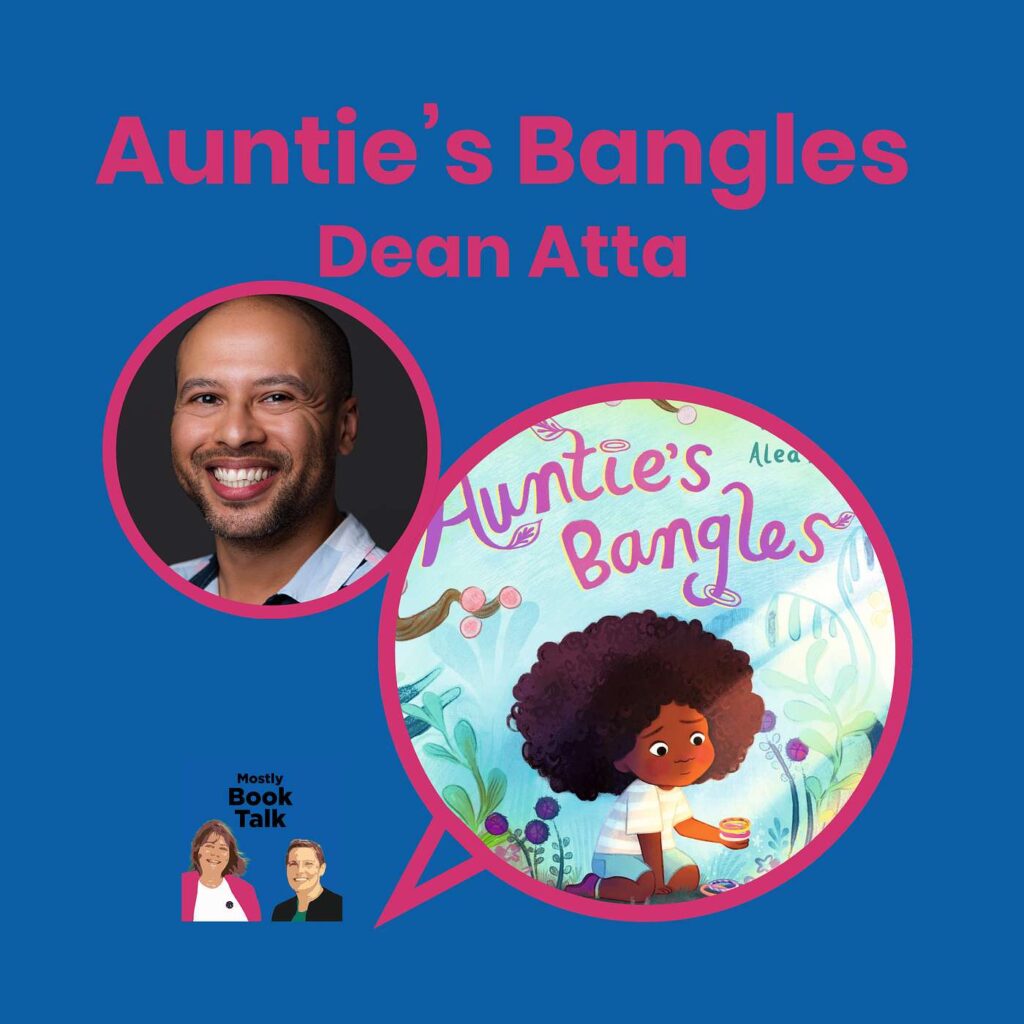
Welcome back to the new school year – we hope you had a great summer. September always feels the time for fresh starts and we are back after a bit of summer break. We have an interview with Dean Atta about his picture book, Auntie’s Bangles (illustrated by Alea Marley)- a joyous take on loss and remembering. We also talk about his YA books and the middle grade project he is working on. All very exciting! Congratulations to him too on the publication of his adult debut, Big Man, which is out and available now (and you will have worked hard to miss the buzz about it on social media!).
Dean’s website can be found here.
And links to all his books are below.
Auntie’s Bangles, illustrated by Alea Marley
Confetti, illustrated by Alea Marley
The Black Flamingo, illustrated by Anshika Khullar
Big Man
Do subscribe, message us about who you would like us to get on the podcast, what you would like us to cover and any questions you have.
Katy
0:12
Hi, I'm Katy.
Ali
0:13
I'm Ali
Katy
0:14
and welcome to Mostly Book Talk.
Ali
0:16
We've had a little break for the summer holidays, and we hope you have too. But, we're back.
Katy
0:21
We are back, yes. And we have a feast of author interviews and other exciting things to bring you. There's going to be a lot of episodes coming out in quick succession, really. We've got a whole load of National Year of Reading episodes, which we've saved up for the starter term for everyone being back. And they are going to be coming out thick and fast, aren't they, next week?
Ali
0:41
They are indeed. There's lots there. So if you've been one of the people interviewed for that, thinking, where is my interview? It's coming soon.
Katy
0:48
It is coming very soon. And there are lots of things there for schools to listen to, find out about activities that they might be doing, organisations they might be working with. Because it is still the National Year of Reading.
Ali
0:59
As we go into the final term of the National Year of Reading. Yeah. And we've also got lots of author interviews, including
Katy
1:06
We have Dean Atta, who is coming up in this episode.
Ali
1:09
Abiola Bello,
Katy
1:10
Claire Linney,
Ali
1:11
Lisa Williamson,
Katy
1:12
Janine Hayet,
Ali
1:13
Pepe Smit,
Katy
1:14
Tom Palmer,
Ali
1:15
Chante Timothy,
Katy
1:17
and Isaac Hamilton Mackenzie.
Ali
1:19
Those are coming up very soon because they're in the bag mostly.
Katy
1:22
So first up, we have Dean Atta, and we talk to him about his lovely picture book, Auntie's Bangles, and about his other books as well.
Ali
1:31
We do. And his book Big Man has just come out as well. So you've probably seen him on socials because he's had the book launch of that and that's out in the world out.
Katy
1:39
But it's a book for adults.
Ali
1:40
Yeah. And it was quite interesting actually because he was saying about writing for different age groups and covering similar themes, but being aware of who he's writing for when he's writing. So we talk about that a bit in the interview as well.
Katy
1:52
Yeah. So enjoy.
Ali
1:54
Uh what was the other thing I was going to say? Oh yeah. And we would really, if you're enjoying the podcast, get in touch, send us a comment, tell us who you'd like to hear from and hear about, and follow us on our socials.
Katy
2:05
And subscribe. So subscribe, message us, follow us, do all of those nice things because it all really helps. So we're very pleased to have with us today Dean Atta, who is a poet, an author, a performer, a screenwriter. And he has just brought out a new picture book in paperback called Auntie's Bangles, which we're going to talk to him about. So welcome, Dean.
Dean
2:33
Thank you.
Katy
2:34
Can you just start by giving us the short version of your journey as a writer and an author?
Dean
2:40
The short version is I wrote poetry for myself as a teenager in an attempt to understand who I was, like being mixed race, being gay, other things I wrote about was like my dad not being around when I was growing up, that had an impact on me, and that comes through in some of my writing for children. And yeah, identity in lots of ways played a part in what I wrote. And I kept it to myself for a while. And then I showed a few friends, and those friends encouraged me to share it further. And then I started doing open mic nights around London and had a piece of poetry on Radio 4 after someone at an open mic invited me to go on Radio 4. And so things snowballed from there. And I got lots of performance opportunities and started sharing far and wide. And then 10 years into performing, I was encouraged to publish my first poetry collection. And then the rest is history.
Katy
3:39
How old were you when you were first doing the open mics?
Dean
3:42
Like in my teens. Yeah, 15, 16. Yeah. And then when I went to university, I literally called myself a poet. When I was meeting new people, I went to the University of Sussex and I'd be like, hi, I'm Dean, I'm a poet. And then I'll be performing at the poetry night. Come along and see me. And I'd just be like that, really precocious.
Ali
4:01
Is that on your passport, Dean? Poet. Did it say poet on your passport?
Dean
4:05
Do we put occupations on passports?
Katy
4:06
Probably more like when you're applying for house insurance. You say, What's your occupation? I'm a poet.
Dean
4:11
Poetry passport, though, that's a good kind of title for something. Now you've got me thinking.
Katy
4:20
So you've written adult poetry, but you also write in verse for children.
Dean
4:25
So yeah, that came from once I had my poetry collection out and I was doing a lot more literature festivals and a lot more school visits as well. And even though it was an adult poetry collection, some English teachers just wanted to share it with their students. And so I would go in and perform my poems and do writing workshops, but I was always a bit nervous because it is adult themes in the collection. And so I started thinking about what I would write for children, like specifically for children, really thinking about them. And yeah, I had an agent by that point, and I was building a new poetry collection, and we had a conversation with an editor about whether could this be a novel in verse instead of a poetry collection? And I went and looked at some novels in verse, including The Poet X by Elizabeth Acevedo. I looked at some other novels in verse and realized I could do it. I understood how they worked and I liked what they were doing, the kind of close to the character, first person, present tense, like getting to know the character and their life really quickly, and then something happens. They're quite pacey and really easy to read. And I'm dyslexic, so I love how easy novels in verse are to read. Like the line breaks, the white space, all of it just makes it easy to follow for me and easy to write, it turned out. And yeah, so the black flamingo came from that, from wanting to have something for the young people I was regularly visiting in schools, and also yeah, being encouraged by an agent and editor that this also might be more lucrative than poetry.
Katy
6:04
Because it's highly illustrated as well, isn't it? Um, how did that part come about as well?
Dean
6:09
Yeah, so and Anshika Khullar was found by my publisher, Hachette Children's Group, and Alice Duggan, I think, had a hand in that who was doing the design of the book. It was a kind of team effort in terms of finding the right illustrator and then briefing them, which the editor Polly Lyle Grant did and yeah, showed me bits and pieces. But really, I was learning this whole new process of making books this way. I've never really worked with kind of an intermediary like between me and an illustrator. I've worked with an illustrator directly before for another project, an illustrator called Ben Connors, and we were doing live illustrations with my poetry and working on things of that nature. But I'd never worked with an illustrator where it's going via an editor. But that's the more common way it works in publishing. So especially children's publishings, unless you're like a married couple or a kind of dynamic duo that comes together and that's just how it is. Usually you'll be paired with an illustrator. And when I say paired, like you'll be told who your illustrator will be. And then it's like an arranged marriage, isn't it? That's exactly it. It's like an arranged marriage. And it was a wonderful one because that book is so beautifully illustrated. And yeah, I love that because the US version of the book isn't illustrated. They didn't think their teen market needed an illustrated book. So it's only the UK and maybe some other territories, but yeah, it is such a special book, and it is beautiful. The cover, the illustrations, all of it. It's just stunning, and it just really helps people see the world and the characters.
Katy
7:51
It's a whole package, isn't it? I think that kind of brings the whole world alive. And then so you're we wanted to talk about your pitch books as well, which is obviously another collaboration with Aliyah Marley on both books. How did that come about? Was that the traditional route of the publishers' finding? Yeah.
Dean
8:07
So all my children's books so far have been with Hachette Children's Group. And yeah, with Confetti and Auntie's Bangles, I wrote the manuscript of the book, which is 500 words or so. And with Confetti, it was just a poem. It was just all on one page. Whereas with Auntie's Bangles, because it was the second, I thought about the page turns and where that would be, but I never said what the pictures should be like. I completely left that to the editor and illustrator to decide. And yeah, me and Alea have never met. We've had I think one Zoom and some messages on Instagram, and that's it. Yeah, it's a funny one, but it's beautiful. So that's the thing. The work is so beautiful. And I knew the second book that I'd love to have Aaliyah illustrate that one again. And of course, Hachette agreed because we all think her work is beautiful. Everyone that's worked with her feels so lucky. But yeah, for people thinking it's like a back and forth between writer and illustrator, it's often not that. So there is one author and illustrator pairing that I actually made. I introduced Nathan Bryon, and Dappo Adiola when Nathan was looking for an illustrator. I had seen Dappo doing amazing work at events like live illustration style stuff, and I thought they'd go really well together. So they came as a pair when they went to a publisher, and I guess their publisher knew that made sense. And LookUp and all of their books together are just so special. And I think Look Up was a big inspiration for me writing Confetti because I love seeing books with little black girls in. And I've got two nieces, Ari and Andy, and they actually are the characters in Confetti. I named them after them because I just wanted to see more books that is about a little black girl but isn't about her hair or something of that nature. Because we have a ton of those books now, and not to say we won't have more good ones, but I think we deserve all kinds of stories about all kinds of people. So confetti was based on a real event where my niece Ari had found a piece of confetti under the sofa after her birthday party and started playing with it, and it was like she was reliving the party again. And then I thought about all the special moments where we get to celebrate. And so I included a fireworks display, a wedding, a pride parade, and a baby shower, and so many lovely moments, and then the snowball fight at the end with the uncle, and that it was just so fun to write and then to see come to life with Alea's amazing illustrations. It's just a stunning piece of work that I'm gonna be proud of forever.
Katy
10:46
Yeah, it's just joyous, the whole thread running through it. It's beautiful. Can I ask, what do your nieces make of it?
Dean
10:52
Because publishing takes a time. We got like drafts, and I was like, shall I show them now? Obviously, my sister knew about it because I was gonna be using their names, so I wanted to be sure she was okay with that. And then I showed them once we actually had the illustrations, full colour, like a proof. But the proof isn't bound very well. It's just to show you it. It's like a mock-up. And so I gave it to Ari to have a look through, and it started falling apart, the pages started falling out, and she cried and she was like, It's broken, my book is broken. And I was like, We're gonna get proper ones soon, they won't do that. So then when the final books were done and she had many copies now, she's got artback, paperback, she's got copies at her school, she's got a copy at home, and they both her sister has a copy of both as well. My sister has, and my mum has. So they've got copies at their grandma's house, at their house, and they've come to some of our readings. Obviously, the book launch, but also some readings I've been doing at Tate Britain in their story space, which I actually helped redesign not so long ago, inspired by confetti and the colours of the rainbow flag, which is featured in the book. So the story space at Tate Britain is called Rainbows right now, and that's inspired by Confetti and taking them to that space, telling the other people there this book is about them. They love it. But I think the most recent time, because we did an event recently where I read Aunties Bangles and Confetti, they're that much older now, so they were like three and one when the book first came out, and now they are like nine and eleven.
Katy
12:34
There's gonna be a point when they're gonna be embarrassed by it, you know that. Yeah, uncle's brought us here to smile, so they're not going around signing copies of it in Waterstones.
Dean
12:47
No, but I remember when Black Flamingo came out and we had a launch for that at Gay is the Word, and I was doing a signing there, and my nieces were there, and Ari wanted to sign as well, and so she got a pencil, and whoever wanted it, she signed their book too, even though that one had nothing to do with her. She just wanted to be part of it. But no, I didn't get her to sign copies of Confetti, but yeah, I don't even know if she has a signature as such, but she can obviously write her name. But I think that it's a lovely thing for her to know she's in that book forever, and that's her story. And then yeah, it was funny because Auntie's Bangles, they're not in that one, it's not about them, and so they were like, Oh, are you gonna do another confetti? And I was like, Oh, maybe, but this one is what I needed to write right now. This is the story that I needed to tell. So Auntie's Bangles is very different to Confetti.
Katy
13:39
Yeah, and can you tell us a bit about that? Where did the idea for Auntie's Bangles come from?
Dean
13:44
Well, it did come from my nieces still, but conversations we were having with them after my grandparents, their great-grandparents had both passed away, and they were asking about death and what death means. And we had gone to the British Museum and they saw the mummies, and they were like, Are those bodies? And we were like, Yeah, and they're like, Why are they not in a grave? And it's that's a whole story about, but they were like, Will they come back to life? And it's no, you don't come back to life when you're dead. But then they were asking about all the items around the mummies, so there were things in jars and stuff, and and that kind of got me thinking about like how do we remember people? We remember them often with objects. I've got some objects from my grandfather, so I've got his prayer beads, I've got his watch, and I keep those, and and then a Greek icon of his saint St. George, because his name was George. And I have those items and I look at them when I want to think about him, but I also, there's so many other things that make me think about him. And with my grandma, it's actually not objects, it's food, it's recipes. So I make certain dishes that she used to make for me when I want to remember her. There's a a chicken, lemon, and egg soup called Avgolemono, which is like a Greek dish, which I love to make, and I think of my grandma whenever I make that. So kind of combining those ideas of like food and objects, this is how I thought we could remember Auntie with her bangles, with the dishes that she would make, which was in the book It's chapati and Masala Dall. And she would wear her bangles to dance, dance at weddings, but also dance at home with Theo and Rama. And yeah, and then also books. She gifted them lots of books. So they have books that say to Theo with love from Auntie. And I gift lots of books to my nieces. And for me, that is a really special thing that you can give to people, and they can be close to you or feel close to you, looking at those and reading those. And that they're not holding you, but they're holding something that you've held. So yeah, and I think story time is a really special thing for children. Children love to be read too, and yeah, that's something that Auntie had done with both Rama and Theo. And so when they read the books, they feel that love of the story times that they'd had with Auntie.
Katy
15:59
And there's quite a lot of sounds in it, the jingle jangle that runs right the way through. Do you write it thinking about it being read aloud and how it sounds?
Dean
16:07
Yeah, because it was my second picture book, I knew a bit more about what picture books' events would be like. And you need to have that dynamic energy to engage the children. And there's a lot of repetition in Auntie's bangles as at the page turn. There's the last line or word of a page will be the first line or word of the next page. So that repetition keeps the flow for me. I really enjoyed writing it that way. And the jingle jangle, yeah, is something that I can say when I read it out to kids. When I say jingle, you say jangle. When I say auntie, you say bangles, and it's just really fun. And I get them to show me their best dance moves, but they also will tell me about their favorite foods and their favorite toys because toys feature in it as well, and then their favorite books. And yeah, they love going on a bear hunt. They love the hungry caterpillar. But yeah, I'm like, have you heard of Julian is a mermaid? Have you heard of look up? I'm just trying to introduce other stories to them as well. But yeah, it's it's really fun because I get an insight into so much about and children love telling you about themselves, they actually love telling you what their favorite foods are, or a bit about their auntie if they have one, and or who in their family wears bangles. And it's just so lovely to have those connections with children. And they really do focus on the joy of it. They understand death because there's a bit in there where Rama's not speaking, she's not speaking to Theo, she doesn't want to play because she's sad, her mum has died. And I say to the kids, why is Rama not speaking? And they're like, Because her mum's dead. And I say to the children, why is Rama not speaking? And they say, She's sad because her mum has died. And they understand that bit, but then they also understand that there's the joy in remembering and putting on the bangles and dancing, and also there's a theme in the book about kindness. And Theo, who is Rama's cousin, is trying to be kind and be considerate to her and try and make her feel better. And his mum says, It's not necessarily your job to make her feel better, but you can keep being kind, and he knows he's kind. That's something he's been told and it's been affirmed by his mum, his dad, and auntie that he's a kind person. So that's how he sees himself, and he wants to be kind to Rama. And when Rama does receive kind of some of his kindness, it feels good for him too, because he really wants to support his cousin. And when they have their hug in the book, I ask all the kids to hug themselves when I'm reading it, and they all do it, it's so cute. And I say, How do hugs feel? And they really know that that hugging with someone that you care about is a lovely thing. And I ask them how they are kind, and they say, I will tidy up, I will share my toys, I will help with cooking, I will say nice things, I will say thank you, I say sorry, and that's a kind thing too. And that's really lovely that children understand kindness on to that level, and it's just yeah, great to show it in the book, but also hear it from the children themselves that I've pitched it right. Like when you come up with a topic like grief and you think, oh, this is gonna be for kids, you're like, how am I gonna pitch this? And obviously, with all the readings I've done, it is pitched right for them, and they can totally get it and yeah, connect to it, even if they haven't lost someone. They just understand the element of being kind to someone who's sad because Theo is sad that his auntie has died, but he understands, I think, that Rama's even more sad that her mum has died, and so he's trying to be there for her, but then there's a moment in the book where he realizes his own sadness too, which I think is a good moment for Theo where he gets to say, I'm also sad, I miss Auntie. Yeah.
Katy
19:46
And there's space for the adults to be sad too, yeah. As well, because they're holding it together, aren't they? And you've done all that in 500 words, which is amazing.
Dean
19:54
Yeah.
Katy
19:56
And the theme of our aunties and extended families is something that is in a number of your books. And is that from your own life? Because it's in your YA books as well, that idea of having an extended family, other places to go to. What's taking you to that theme? Because it's interesting, because not all children's books have that in it. There's like neat little families for me.
Dean
20:20
Yeah. When you only have had one parent, you look at your aunts and uncles, your grandparents to fill some of the gaps. And they've also just been incredible support for my mum and me and my sister when we were growing up. So aunts and uncles and grandparents have always been really important to me, and that's reflected in all my stories. And then I'm an uncle, and I really feel that responsibility and that privilege. You could be like their best friend and the most fun person in the world and then give them back.
Katy
21:01
So you're not called in then for disciplinarian, you're called in for the confetti and the fun.
Dean
21:06
No, I do discipline, but it's really interesting, like that. I'm firm but fair. I'm just consistent. That's kind of me. If I say something, I mean it. You can't get around me. You can't wear me down. I'm just like, no, this is what I've said. There is a line. Yeah. I've drawn the line. Then you do the really fun thing, and then they're like, one more time again. And I'm like, I'm actually tired now. So we're actually gonna have a break for five minutes. And then and because little kids don't necessarily know time, so I'll set a timer. When the timer goes off, we can play again. But let's have a little break and drink our water and have our snack and just be still. Outside of my immediate and extended family, there is other aunties and uncles that I've had who are not blood but chosen family, or people that have stepped in and been mentors, or these kind of like adults that have, when I was growing up, just were there for me and my. My mum would either introduce them as auntie or they would self-appoint themselves my aunties. And yeah, and it's lovely now with my friends' kids. I get referred to as Uncle Dean. And at first I was like, no, that's reserved for just my nieces, but now I'm like, sure, I'll be everyone's uncle. It's okay. As I'm getting older, I don't mind being everyone's Uncle Dean.
Katy
22:25
And you write across so many forms with the poetry and the picture books and your film as well. We've not talked about that. A memoir. How do you decide what your next project might look like?
Dean
22:36
Is there a structure or is there a plan? They're often working in parallel these days. When I started out, I only thought I could do one creative project at a time. But now it's not possible to just do one thing. And for example, the film you mentioned that took five years to make. So whilst that animation, it was a stop-motion animation. So while that was being made, I wrote and published three books. There's other things that you're doing whilst one thing is still being completed. So yeah, for me, there's crossover, and I don't mind that because I'm writing for different ages. The animation is a 15-rated film. So that's for older teenagers and adults. So that's going to reach one audience, whereas my memoir is also for adults. And then Auntie's Bangles and Confetti are for little kids, three to six year olds, and then the YA is 12 plus. And then I'm now working on a middle grade for eight to 12 year olds. So often it's what do I want to write for this age group? And it doesn't matter to me if some of the themes have been covered in my poetry for adults or my film that's for adults because this is now for middle grade. So this is a different age group. So I can write about an absent father, or I can write about grief, which both things are in my middle grade book that I'm working on. But yeah, it's a different age group and I feel it's a different story. This new book that I'm working on is in a fantasy world as well. It just gives me a lot of kind of freedom to look at this from a different angle. I I have certain themes that just matter the most to me and I feel best placed to talk about, write about. And so that makes sense for me to go back to certain things and look at them slightly differently.
Katy
24:20
And is your middle grade going to be in verse or is it going to be in prose?
Dean
24:23
Watch this space.
Katy
24:25
Oh, you're not allowed to say. I don't want to say.
Dean
24:29
I'm allowed to do anything.
Katy
24:30
I just wondered because it's interesting, you've written three YA books in in verse. I have. And we were going to ask whether there was something, because we feel that it's a format that this is a bit of a leading question, but that particularly suits a YA audience. And I'm just interested, if you're looking at middle grade, whether there's any difference there. But for a YA audience, you said a bit earlier about why it works so well, but was there something particularly about matching the writing and verse with a YA audience that took you down that path?
Dean
25:03
No, it was an entry point from poetry into telling a kind of book-length story, really. It made sense for me. And it was that I'd seen many great YA books for kids. So the books by Sarah Crossan, as I mentioned, Elizabeth Acevedo, Jason Reynolds, Kwame Alexander, all of their books written in verse. Like I loved them. And I was just like, I just want to be part of that. That looks really fun. And I think the same was true with the move into middle grade. Like I was, and I was reading books old and new. So I think I'd read Skellig and then I wanted to read the new book, The Falling Boy. And then I was reading also A Monster Calls, but then I went way back to read The Phantom Toll Booth. And I was just reading all these middle grade books that I just like found really fascinating. And books with boys in. I was thinking about what I could offer the middle grade space. And I thought, a little boy, basically. But there's a boy and a girl because like I was always friends with girls when I was little, and I like that dynamic of a boy and a girl being best friends and and what people might project or assume or ask them. And so I was enjoying reading middle grade, and I was like, I want to join this party now. So that's all it is, really. I want to go where like I am most fascinated. And so that's it. And I've got a friend called Maisie Chan who writes amazing middle grade books, and I was loving what she has been doing and her character of Nate Yule. I was just like, I love this boy, and I love this kind of the ants and the ghosts and all the fun stuff that she puts in there. And I'm like, yeah, middle grade is fun. I want to write a fun book that is just exciting to read. And yes, there's gonna be some signature Dina to like deep bits like I'll pull at your heartstrings, but I do also want it to be fun and exciting and pacey. So that's what I think middle grade wants of you, or the middle grade readers want of you, and therefore the middle grade editors ask of you. But yeah, to answer your question, verse because I was reading some amazing verse novels and middle grade because I've been reading some amazing middle grade novels, same with picture books. When I read Look Up and then Julian is a Mermaid, I was like, I must do a picture book. I must do a picture book. And I was reading things, classics as well, to my niece's Bear Hunt. And I just was like, maybe I can come up with a classic. I don't know, but you don't know till you try, you've got to give it a go. So yeah, it's just been following the passion. And whether that's about the form or the age group or the theme, I just go with it and I and then I think about who will publish it after. I don't let some authors will write what their editor wants them to write next, almost. I won't say who, but that's what people have told me. They'll have a little chat with their editor, and their editor will steer them in a direction or shoot down some ideas that they are interested in, and I don't like to get shot down. I'm like, this is the idea, take it or leave it, or take it or else. Yeah, like Dean At as a tyrant. No, but definitely will fight for the stories that I want to tell, which means taking them elsewhere if I need to, or just keeping at it and showing them to people. If there's a problem with them, I'm always up for getting friends in to read, having sensitivity readers read, making sure I'm not doing anything that could be irresponsible or harmful. But if I want to tell a story, I'm gonna tell the story. I'm just gonna get the help I need to tell the story well.
Katy
28:48
Do you have a team? Sounds very grand, doesn't it? Do you have people who you first show the story to, whatever it is?
Dean
28:55
Yeah, depending on what it is, yeah. So like the first people to see Auntie's Bengals were a poet called Nikita Gill and Maisie Chan, as well, the middle grade author, and Bhavika Govil, who writes adult books, but yeah, because I trusted her judgment and because Auntie in the book is Indian, I wanted at least a couple of Indian people to read the story and check that was all good. And yeah, because they're a mixed family, black and Asian, and so I wanted that to come across clearly, but not be what the story's about. Do you know what I mean? And then with some of my other books, a poet and uh academic called Keith Jarrett has read some of my books first, but I've also had another poet, Melica Booker, read my Black Flamingo, and then friends like Travis Alabanza would read Only on the Weekends. And yeah, I trust whoever feels right for the story often because if there's someone in the book, a character in the book that's outside my lived experience, I will get friends and then also sensitivity readers to check that because I'm really up for that. I love that actually. Because not all the boys, all not all the characters I write can be mixed race, Greek Cypriot, and Jamaican boys. Imagine. I would get a bit samey because I already actually have in I Can't Even Think Straight and Black Flamingo, the boys are both mixed race, Jamaican and Greek Cypriot. And I had to make a nod to that. So there's a reference to Black Flamingo in I Can't Even Think Straight to acknowledge this kind of repetition. And also say they are in the same world. So like the character of Kai mentions the Black Flamingo as a drag queen that exists in the world. So I thought that was really fun because I'm kind of like, and he's he's mixed, he's got the same mix as me. Isn't that cool?
Katy
30:46
What a surprise! What a surprise, yeah.
Dean
30:49
But yeah, I am wanting to go beyond that because I think it's not an incredibly rare mix, but it still feels like people will start to be like, every character Dean? Come on, like brilliant, brilliant.
Katy
31:03
So, what's the timing? You're not going to tell us anything more about it, but what's what timetable are you working for in terms of your what next?
Dean
31:10
So, yeah, the middle grade would be next autumn 2027. Yeah, and I guess I'm not saying too much because we haven't pinned down the title, and that's been really interesting. Every other book, the title I came up with, whereas this one we're having a bit of back and forth around the title, which lots of my friends have had in the past. I've just not experienced it before. Yeah, it's something new for me. And I'm kind of like, because usually the title informs what the book is about. The black flamingo is about the black flamingo. Auntie's bangles is about aunties bangles, confetti's about confetti. You see what I mean? And yeah, it's been interesting with this book. If I told you what the kind of working title has been, that's exactly what the book's about. However, we're thinking, do we want a title that's slightly more enticing that tells you a bit more or a bit less? That is like making it clearer of the fantasy element or other thematic elements. And do we want the character's name in the title? Because a lot of fantasy adventure books do that. So there's just so much to consider. And I'm also doing some edits. Sometimes I like if a title can be a line from the book, that's quite fun. But watch this space, and it's really fun. A new age group for me, middle grade, and it's with a different publisher, and it is all very exciting, and it's obviously a different genre because it's fantasy. So it's just wild, but I love it because I it keeps me excited and doing new things, and I'll get to meet a whole batch of different authors. I've already had a chat with Catherine Rundell about this book, and she's yes, send it to me. And I'm like, I shall, Katherine Rundell.
Katy
32:52
It sounds brilliant. It sounds like you're having a lot of fun doing it.
Dean
32:55
Yeah.
Katy
32:56
So just finally, we ask people if there are books that you think are maybe under the radar or you would really recommend. Have you got a book that you would go read this?
Dean
33:07
Yeah, I think, especially as we're recording this during Pride Month, I would recommend Jacob's Transition Goals by Arthur Weber. And it's about a boy called Jacob who is a keen footballer. He's a trans boy, and so he has to change which gender team he plays on. And he is incredibly supported in doing that. And it's about how we can support trans kids and how we can celebrate them and affirm them and stand alongside them and play alongside them in sports. And it's just a really lovely book, and it includes an author's letter, which is, I think, really thoughtfully done and great illustrations. You get to feel the kind of excitement of football. I've never been into football, but reading this book, I was like, it makes it so fun. It's like when I read Kwame Alexander's The Crossover, which is a YA novel in verse about basketball. I was like, oh, basketball's so fun. Did I go and play basketball afterwards? No. But I loved reading about it. And will I go and play football after this? No. But I loved reading about it.
Katy
34:09
And it's the World Cup, so you can very easily watch a bit of football. Yeah, I shall.
Dean
34:13
I'll give it a go. I think that's currently under the radar only because it's new and I'm sure it's going to be a beloved book of many football fans, trans kids, and just families that want to have diverse stories in their collections. So yeah, I definitely would recommend that one.
Katy
34:29
Brilliant. Thank you. You're welcome. And thank you very much for your time. And yeah, we look forward to seeing the middle grade. We will be looking out for that. I'll come back and talk a little bit.